Standard Bots Pitches Automation Playbook at Automate 2026
This article was featured in Machine Design’s Automation & Robotics Takeover Week (July 13-17, 2026).
For more Automate 2026 coverage, be sure to visit our Tradeshow Takeover event hub.
As governments and manufacturers look to revive domestic production, a growing number of robotics companies contend that the next industrial divide will not separate low-cost economies from high-cost ones, but factories that automate from those that do not.
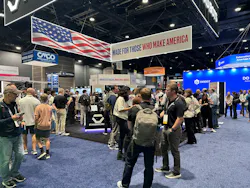
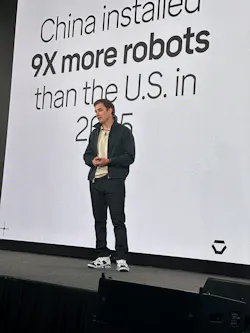
That was the central message from Standard Bots at Automate 2026 in Chicago (June 22-25), where the company argued that manufacturing competitiveness and robotics adoption have become inseparable. In its view, the United States has fallen behind global rivals not simply because of labor costs, but because it has underinvested in automation while countries such as China have aggressively expanded robot deployment and treated industrial robotics as a strategic priority.
During a keynote address, CEO Evan Beard pointed to the consequences of that imbalance, arguing that high domestic production costs and slow robot adoption have widened the productivity gap between the United States and manufacturing powerhouses such as China. Only about 6% of U.S. manufacturers currently deploy robots, according to the company—a figure Beard cited as evidence that automation remains largely out of reach for much of American industry.
Framing automation as essential to competitiveness, Standard Bots calls for robotics to move beyond pilot projects into production scale, with tighter human-machine collaboration and easier integration at the core. The message aligns with policy discussions in Washington, where, in testimony before the U.S. Congress Joint Economic Committee in November 2025, Beard outlined a complementary agenda: a nationwide network of Manufacturing Excellence Centers, expanded access to capital through a national manufacturing loan program, targeted efforts to close the industry’s talent gap, and action to address widening global disparities in robotics adoption.
Beard noted that Standard Bots, which operates from its newly built 70,000-sq.-ft. facility in Glen Cove, N.Y., aims to manufacture all of its robots domestically by 2027 while capturing 10% of U.S. industrial robot deployments.
What’s Driving Faster ROI in Industrial Robotics
Against that backdrop, Standard Bots is betting that AI-native robots (machines that can learn, adapt and be programmed by ordinary workers rather than robotics specialists) could become the defining industrial tool of the next manufacturing era. “We believe AI-native robots are the essential power tool of the 21st Century,” Beard told attendees. “They’re like the drill that workers should be able to grab whenever they need them.”
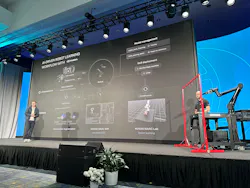
Realizing that vision depends on a new generation of robot intelligence built on simulation, foundation models and demonstration-based learning. Instead of painstakingly programming every movement, operators can train robots through simple interactions: clicking on objects, describing them in natural language or physically demonstrating a task.
“We don’t just program robots anymore. Robots learn,” said Leif Jentoft, Standard Bots’ head of applied AI, describing a shift from deterministic programming toward adaptive systems capable of generalizing across tasks and responding to the variability that has long limited the reach of industrial automation.
Picking Unknown Objects with Ease
On stage, Beard invited Jentoft to demonstrate Quick Find, a vision system designed to eliminate one of industrial robotics’ biggest barriers: programming complexity. In a matter of seconds, Jentoft trained the robot to recognize objects it had never encountered before, first identifying an AirPod case and then distinguishing between full and empty bags, even as their shapes and positions changed across the table.
The demonstration was aimed squarely at high-mix manufacturers, where parts and products are in constant flux and reprogramming robots can quickly become a bottleneck. “You want to be able to train it quickly,” Jentoft said.
READ MORE: The Eyes of Automation: Machine Vision’s Role in AI-Powered Automation
The demonstration reinforced Standard Bots’ assertion that robots should be taught, not programmed. By placing physical AI in the hands of frontline workers, the company believes automation can move beyond the domain of specialists and become a practical tool that employees can use, adapt and retrain on the factory floor.
To reinforce that point, Beard and Jentoft also showcased Text Find, which allows users to identify objects through natural-language prompts, an integration with Roboflow for building custom inspection models, and an AI agent capable of generating robot routines conversationally. They also previewed Show Path, an end-to-end AI capability that enables operators to teach robots tasks by demonstration, allowing them to adapt to the variability that has traditionally made automation expensive and difficult to deploy.
How Automation is Shifting from Custom to Scalable Systems
The technology push was paired with an equally ambitious manufacturing agenda. Standard Bots said its systems are already being used in applications ranging from machine tending and welding to palletizing, assembly and inspection and it reiterated its goal of producing fully American-made robots by 2027.
The company also announced a three-year warranty and 24/7 customer support with a target response time of 30 minutes, underscoring a strategy that places reliability and ease of ownership alongside advances in artificial intelligence.
Underlying Standard Bots’ strategy is the contention that automation will only achieve broad adoption if robots become easier to use and more adept at handling real-world variability. In Beard’s view, they can become the “power tool of the 21st Century” only when the average worker can pick them up and use them with little specialized training.
About the Author
 Rehana Begg
Rehana Begg
Editor-in-Chief, Machine Design
As Machine Design’s content lead, Rehana Begg is tasked with elevating the voice of the design and multi-disciplinary engineer in the face of digital transformation and engineering innovation. Begg has more than 24 years of editorial experience and has spent the past decade in the trenches of industrial manufacturing, focusing on new technologies, manufacturing innovation and business. Her B2B career has taken her from corporate boardrooms to plant floors and underground mining stopes, covering everything from automation & IIoT, robotics, mechanical design and additive manufacturing to plant operations, maintenance, reliability and continuous improvement. Begg holds an MBA, a Master of Journalism degree, and a BA (Hons.) in Political Science. She is committed to lifelong learning and feeds her passion for innovation in publishing, transparent science and clear communication by attending relevant conferences and seminars/workshops.
Follow Rehana Begg via the following social media handles:
LinkedIn: @rehanabegg and @MachineDesign
YouTube: @MachineDesign-EBM