Integrated Drives and Humanoid Joints Highlight maxon’s Automation Push
For more Automate 2026 coverage, be sure to visit our Tradeshow Takeover event hub.
At Automate 2026, a quick stop at the maxon booth quickly turned into a rapid-fire tour of motion technologies. Familiar to Machine Design audiences, the team walked through a series of component demonstrations, highlighting the latest additions to its portfolio, including a new integrated drive platform aimed at the evolving needs of robotics and industrial automation and an integrated joint actuator.
A Compact Drive That Simplifies Motion System Design
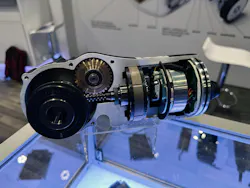
The new compact drive from Parvalux USA (a maxon company) features an integrated motion package that combines maxon’s frameless flat motor technology with Parvalux’s right-angle gear drives.
In the accompanying video, Jacob Gelinas, Sales Engineer, Parvalux USA, noted that the drive is housed in an IP67-rated enclosure. The unit is designed for applications ranging from industrial automation to outdoor robotics, where compactness and environmental protection are key.
READ MORE: Key Component Integration for High-Performance Robotic Joints
The drive’s modular architecture allows customers to configure the system with an encoder, brake and a choice of controllers, or deploy it as a motor-only solution. For robotics applications, Parvalux is also offering a Synapticon controller option with safety torque-off (STO) functionality, reflecting growing demand for functional safety features in collaborative and mobile robotic systems.
Gelinas noted that by integrating motor, gearing and controls into a single package, the company is positioning the compact drive as a flexible building block for machine designers seeking to reduce system complexity without sacrificing performance or safety.
Supply Chain Resilience for North American OEMs
Alex Valentino, Head of Sales, Parvalux USA, added that the Compact Drive is already available for customer sampling in its 76-mm configuration, the mid-sized offering in a three-product family. A smaller 60-mm version and a higher-torque 90-mm variant are expected to enter sampling later this year. Full-volume production of the 76-mm model is scheduled to begin early next year, with the remaining sizes following in subsequent quarters.
Valentino said the drives are being developed and manufactured in the United Kingdom, a strategy intended to provide customers with a more resilient supply chain. He noted that many North American manufacturers increasingly view the U.K. as a lower-risk production base, citing relative tariff stability and a more predictable sourcing environment compared with some other regions.
maxon Targets Humanoid Robotics with Integrated Joint Actuators
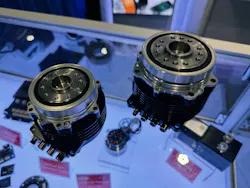
In addition to the compact drive, maxon also highlighted its growing focus on mobility and humanoid robotics. Biren Patel, Business Development Manager for Mobility Products at maxon, demonstrated one of the company’s integrated robotic joints designed for humanoid applications.
The actuator integrates a brushless DC motor, a back-drivable two-stage planetary gearbox, dual encoders and integrated control electronics into a single package. One encoder provides end-of-shaft position feedback, while the second handles motor commutation. The unit requires only power and an EtherCAT connection, with an optional external fan available for applications requiring additional continuous power output.
Patel showcased two actuator sizes. The larger version is intended for high-load joints such as knees, hips and shoulders, while the smaller unit targets lower-torque applications, including elbows, wrists and ankles, depending on payload requirements.
Modular joint architectures for humanoid robots are placing greater emphasis on reducing component count and simplifying system integration as developers transition from prototypes to scalable production platforms.
“The purpose of designing these robotic actuators, what our vision is, is to make it simple for roboticists to worry about the robot itself,” said Patel. “We think the roboticists should worry about that part of it and not the actuator build. What we’re doing with these actuators is simplifying that part of it for them by taking into account heat dissipation of the motor, how to make it compatible with the gearing, how to make the encoders compatible, how to route those cables and everything else back to the controller.”
In doing so, maxon aims to simplify work for roboticists by providing an actuator with everything integrated into one torque dense product.
About the Author
 Rehana Begg
Rehana Begg
Editor-in-Chief, Machine Design
As Machine Design’s content lead, Rehana Begg is tasked with elevating the voice of the design and multi-disciplinary engineer in the face of digital transformation and engineering innovation. Begg has more than 24 years of editorial experience and has spent the past decade in the trenches of industrial manufacturing, focusing on new technologies, manufacturing innovation and business. Her B2B career has taken her from corporate boardrooms to plant floors and underground mining stopes, covering everything from automation & IIoT, robotics, mechanical design and additive manufacturing to plant operations, maintenance, reliability and continuous improvement. Begg holds an MBA, a Master of Journalism degree, and a BA (Hons.) in Political Science. She is committed to lifelong learning and feeds her passion for innovation in publishing, transparent science and clear communication by attending relevant conferences and seminars/workshops.
Follow Rehana Begg via the following social media handles:
LinkedIn: @rehanabegg and @MachineDesign
YouTube: @MachineDesign-EBM