MD&M West 2026 Booth Briefing—How Electric Brakes Enable Exact Positioning in Medical Equipment
Key Highlights:
- Electric brakes in medical devices require zero backlash to maintain precise positioning and prevent malfunctions such as drift or vibration.
- Design trends include reducing axial length, enhancing thermal management, and customizing torque profiles to fit tight spaces and specific application needs.
- Integration challenges involve mechanical mounting and electrical considerations like coil voltage and heat dissipation, which are addressed through innovative design and testing.

There’s no room for slop in medical devices. Just ask the electric brakes that depend on precision.
Take the concept of zero backlash. Any measurable lost motion between mating components in medical equipment can be the difference between a system that feels precise and one that feels unpredictable. When electric brakes are used to keep imaging arms stable, secure mobile carts or maintain precise positioning during procedures, even minimal play can lead to malfunctions such as drift, vibration delayed stopping or warped brake rotors.
For design engineers, eliminating backlash in brake and drivetrain systems is essential because it directly impacts a device’s positional accuracy, smooth response and overall safety in clinical settings. At the same time, electric brake designs are moving toward compact, mobile and tailored solutions to support safety-critical medical equipment, according to Jonathan Dagorne, global product manager – Compact Precision Safety Clutches & Brakes, Regal Rexnord.
Shorter axial lengths, tailored form factors and improved materials allow brakes to deliver precise, safety-critical performance in tight spaces, while customizable torque profiles and long-term holding reliability ensure consistent braking accuracy and device stability throughout a product’s lifecycle.
Modified FSBR brakes used in mobile X‑ray machines are just one example of a low-profile electric brake option that’s suitable for applications with minimal space or short motor shaft extensions, according to Regal Rexnord experts. The company has opted to showcase motion systems in medical settings at MD&M West 2026, ranging from surgical robotics and imaging systems to lab automation and powered surgical devices.
Machine Design turned to Dagorne for more specifics on the latest trends, challenges and design considerations for engineers working with electric brakes in medical devices.
Medical device prototyping is complex and costly, particularly when working with microvolume dispensing. Precision dispensing directly influences bond integrity, coating uniformity and dose accuracy in a range of applications.
Among the major trendlines, device architectures continue to shrink and incorporate more complex materials. Manufacturers face increasing demand for tighter volumetric control and higher repeatability. At the same time, regulatory scrutiny and cost pressures are accelerating the industry’s move toward automation, in-line monitoring and data-driven process control.
In this Q&A, a precision dispensing expert at Nordson EFD—Mark O'Shea, senior manager of Business Development—discusses how Nordson EFD collaborates with OEMs to turn early-stage concepts into manufacturable products.
Editor’s Note: This Q&A is part of a series, Machine Design’s “Booth Briefings—SME Insights Shaping MedTech’s Future.” Conversations are centered on and sourced from MD&M West 2026, held at the Anaheim Convention Center in Anaheim, Calif. (Feb. 3-5, 2026).
Check out our full series of MD&M West 2026 Booth Briefings:
Q: For mobile medical equipment where electric brakes are used for parking and holding (not dynamic stopping): What core brake components and specifications matter most, and how do parameters like static torque rating, spring-applied design and power-off operation influence safety and performance?

A: Core brake components include mechanical springs, friction materials and forming and magnet design for optimized performance. Customer specifications and application expertise are extremely important to ensure best selection between available component options.
Our design and test experience with capability to validate different final applications allow product performance selection and our ability to estimate end-of-life product stage without affecting critical safety function of the complete equipment.
Safety also means assessing our product redundancy and SIL rating into customer applications. Brake performance includes high temperature performance, precision with low backlash, reliability with stable static torque and long use with energy dissipation and permissible wear.
Q: For the mobile X-ray application: Space constraints and short motor shaft extensions led to selecting a low-profile, reverse‑mounted brake. What integration challenges do these constraints create, and how do mounting configuration, hub design and custom coil voltage factor into reliable system-level brake performance?
A: Each customer offers different integration constraints, both mechanically and electrically.
For mechanical integration, key challenges are to meet end-of-life performance while providing diameter vs. length best proposal. Our wide product portfolio with different product lines offers the possibility to look at different options with quick prototyping close to the final brake solution.
For electrical integration, key challenges are to reduce brake heating and consumption while ensuring our product life. Our in-house coil design and manufacturing allow us to design different voltages and validate electrical design with final equipment brake control.
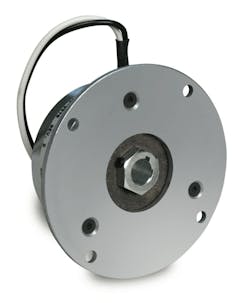
Q: Electric brake design trends: How are electric brake designs evolving to support compact, mobile, and safety‑critical applications such as medical imaging—particularly regarding reduced axial length, customization, thermal management and long-term holding reliability?
A: Selecting the right friction options requires balancing between best static performance (such as holding torque) against emergency function (including energy absorption, acceptable wear rates and dynamic torque). Equally important are designs that enable accurate long-term product life.
Electric brake designs are evolving with size reduction between brake axial length and brake diameter, allowing the customer to position the safety brake at their preferred location in the equipment drivetrain. Direct brake integration often offers overall length reduction compared to catalogue motor brake options.
The latest designs also include weight reduction, environmental protection and low consumption, depending on what matters the most for the application.
About the Author
 Rehana Begg
Rehana Begg
Editor-in-Chief, Machine Design
As Machine Design’s content lead, Rehana Begg is tasked with elevating the voice of the design and multi-disciplinary engineer in the face of digital transformation and engineering innovation. Begg has more than 24 years of editorial experience and has spent the past decade in the trenches of industrial manufacturing, focusing on new technologies, manufacturing innovation and business. Her B2B career has taken her from corporate boardrooms to plant floors and underground mining stopes, covering everything from automation & IIoT, robotics, mechanical design and additive manufacturing to plant operations, maintenance, reliability and continuous improvement. Begg holds an MBA, a Master of Journalism degree, and a BA (Hons.) in Political Science. She is committed to lifelong learning and feeds her passion for innovation in publishing, transparent science and clear communication by attending relevant conferences and seminars/workshops.
Follow Rehana Begg via the following social media handles:
LinkedIn: @rehanabegg and @MachineDesign
YouTube: @MachineDesign-EBM
Voice Your Opinion!
To join the conversation, and become an exclusive member of Machine Design, create an account today!
 Leaders Logo
Leaders relevant to this article: