MD&M West 2026 Booth Briefing—SME Insights on Precision Dispensing
Key Highlights
- Nordson EFD recommends early validation and collaboration with fluid process experts to reduce trial-and-error, streamline scale-up and ensure consistent quality.
- Automation solutions like the PICO XP jetting system and PRO Series robots are designed for space efficiency and high-speed, precise fluid application in compact devices.
- IIoT-enabled systems such as PICO Nexμs provide real-time data, remote control and process insights, significantly improving manufacturing control and product quality.
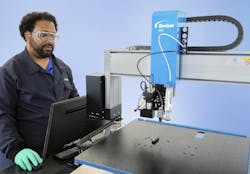
Medical device prototyping is complex and costly, particularly when working with microvolume dispensing. Precision dispensing directly influences bond integrity, coating uniformity and dose accuracy in a range of applications.
Among the major trendlines, device architectures continue to shrink and incorporate more complex materials. Manufacturers face increasing demand for tighter volumetric control and higher repeatability. At the same time, regulatory scrutiny and cost pressures are accelerating the industry’s move toward automation, in-line monitoring and data-driven process control.
In this Q&A, a precision dispensing expert at Nordson EFD—Mark O'Shea, senior manager of Business Development—discusses how Nordson EFD collaborates with OEMs to turn early-stage concepts into manufacturable products.
Editor’s Note: This Q&A is part of a series, Machine Design’s “Booth Briefings—SME Insights Shaping MedTech’s Future.” Conversations are centered on and sourced from MD&M West 2026, held at the Anaheim Convention Center in Anaheim, Calif. (Feb. 3-5, 2026).
Check out our full series of MD&M West 2026 Booth Briefings:
Q: Nordson EFD has decades of experience in precision dispensing. What insights/trendlines can you share about the sector?

A: A longstanding trendline in the precision dispensing space is the relentless push for smaller deposit sizes and extremely precise fluid placement. Currently, medical device assembly organizations can confidently dispense to deposit sizes as low as 50 µm (a human hair is approximately 70-100 µm).
In addition to this trend, the need to design for manufacturability from day one is a strong trend in 2026. An insight we would share with organizations ranging from Fortune 500 companies to startups is to select a fluid dispense partner with a global network of laboratories that uses rigorous laboratory data to guide your manufacturing process. Lastly, challenges around supply chain management remain strong, and we recommend that organizations look to strengthen their supplier partnerships.
Q: Miniaturization is driving next-gen medical devices. How are dispensing systems adapting to tighter tolerances and smaller device geometries?
A: Dispensing systems are adapting to the challenges of tighter tolerances and smaller device geometries by relentlessly pushing smaller deposit size technology and offering a range of dispense technology and automation solutions to meet requirements. In order to meet challenges presented by smaller and tighter tolerances, Nordson EFD recommends collecting and analyzing your fluid dispensing data and making strategic operations and equipment investments.
To expand further on this concept, be flexible about selecting a dispensing syringe or a jetting valve, based on your assembly needs since the type of dispensing technology you adopt is so dependent on the properties of the assembly fluid you use in your process. Similarly, using a reliable system can enable organizations to meet very close tolerance needs while specifying quality into your manufacturing process. Our fully integrated solution set of dispense valves, tips, barrels and more ensures accuracy across the dispense action environment.
Q: What specific insights can you share about managing microvolume dispensing and automated assembly reliability in compact medical devices?
A: The best advice Nordson EFD can offer is to “get in front” of an automated assembly process by working with a validation laboratory—starting at the prototyping phase and continuing the work through relevant phases of product development. Fluid process professionals at Nordson EFD are highly specialized individuals in their scope and in their work. Nordson consultants are relied upon to guide assembly processes from concept to the completed medical device to the final scale. Embedding this unique technical expertise at the prototyping phase yields continuity in the process and more predictable outcomes.
Our team emphasizes that this validation work must occur upstream in the development cycle, as it keeps the drive towards automation front of mind throughout the product journey. This approach verifies that the customer is using the right precision dispensing equipment and the correct fluids and facilitates a faster transition to a fully automated process. Using a stepwise approach to fluid assembly and automation while building your roadmap to commercialization helps clients better manage the inherent changes in the design process without losing control of costly R&D timelines.
In the end, the product scale-up could include manual, semi-automated and/or fully automated fluid dispensing solutions to support the initial manufacturing structure and future scale.
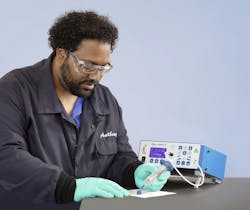
Q: Medical device prototyping can be costly and complex. How do your fluid process engineers work with OEMs to translate early-stage concepts into manufacturable assemblies without repeated trial-and-error?
A: Nordson EFD works in a consultative manner with medical device manufacturers from the initial consultation to lab testing to full-scale production integration. The collective insights of our global team have shown us that when we work with clients upstream at the prototyping stage, the scale up to production is far more streamlined in terms of associated time and cost.
This high-level consulting service is critical for device manufacturers who rarely have fluid process experts on staff to lead the assembly phase of new product development. Clients and potential customers send their materials to Nordson experts for extensive testing utilizing the company’s domain expertise and precision fluid dispensing solutions to assess precision assembly and automation requirements.
Nordson laboratories provide an innovation ecosystem connecting their worldwide client base to industry experts and the technology infrastructure needed to tackle new design challenges coming from diverse bioengineering teams. Nordson EFD fluid process engineers investigate touchpoints along the development path to troubleshoot and solve fluid assembly issues and integrate automated precision dispensing solutions that reliably and repeatedly place micro amounts of fluids onto a material or substrate.
Nordon’s deep knowledge of fluids, viscosity, and how to dispense each liquid to meet the most stringent of specifications is what separates the company from its competitors. These validation labs are located worldwide and are fully equipped with sophisticated dispensing hardware such as automation solutions, robots, dispensers, valves and consumables that are used to ensure the client’s approach to assembly will meet their design specifications.
For decades, Nordson fluid process experts have evaluated and solved many unique challenges of medical device assembly for many types of products from catheters to high-tech wearables. Their sole focus is to ensure consistent, accurate application of epoxies, adhesives, solvents, silicones, reagents, biomaterials and other fluids for manual, semi-automated and fully automated assembly operations.
While every project is exclusive, the collaborative nature of the process allows clients to tap into Nordson’s deep well of hands-on expertise, intricate knowledge of industrial fluids and the technology needed to dispense them down to micron-level specifications.
Nordson is an original equipment manufacturer (OEM) with a deep product portfolio that translates to customized precision fluid dispensing solutions that can accommodate the R&D prototyping process to full-scale production integration. Along this journey, our teams are collaborating with engineers, fluid providers and machine designers to improve process control, throughput, quality, cost-efficiency, as well as data-driven optimization. The end result is manufacturable assemblies and a roadmap to high volume production.
Q: With products like the PICO XP jetting system and PRO Series robots, what should design engineers consider when integrating high-speed, precise fluid dispensing into tight, automated medical assembly lines?
A: Medical device engineers that are looking for assembly automation and space optimization should be looking at dispensing systems that are modular and configurable with smart connectivity. For example, the PICO XP jetting system was designed with space optimization in mind for applications such as medical device and embedded electronics assembly lines.
The PICO XP system offers small form factor solutions through its core components: 1) the PICO Pµlse XP jet valve, which is designed for high-speed, precise micro-deposits and 2) the PICO Nexμs controller that is key to space-saving integration in existing cabinets, saving valuable factory floor space. This controller features compact DIN-rail mounting that saves space in machine builds, which is crucial for complex automation.
The controller also uses standard 24V, which allows machine builders to install multiple units to fit in tight cabinets for smart factory connectivity. Nexμs integrates with factory automation (PLCs, HMIs) via Industrial Ethernet, enabling data-driven control without large control boxes.
And there are other factors and products that provide space saving advantages. The xQR41 MicroDot Valve has a 60% smaller body than traditional valves for tight spaces. In addition, entry-level, compact desktop robots such as the E-Series robots are available in smaller working envelopes (e.g., 200x200mm) for precise, automated fluid application within a small footprint.
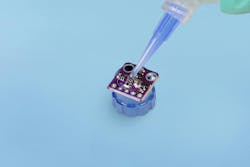
Q: Industrial IoT is changing factory operations. How can IIoT-enabled dispensing systems, like the PICO Nexμs, give engineers better control and feedback over fluid placement, quality and process optimization on the production floor?
A: The operative word for the PICO Nexμs is connectivity that delivers real-time insights for data-driven process control and production.
The industry introduction of Nordson’s PICO Nexμs Jetting System marked a new era in precision fluid dispensing applications as it integrated fluid assembly automation with all the bonus benefits of IIoT. The product’s web-based interface enabled remote programming and on-demand inspection of fluid dispensing functions at the point of dispense from a personal computer, laptop and other mobile devices, which dramatically boosted multiple layers of productivity.
The PICO Nexμs features a smart controller that integrates precision fluid dispensing with smart factory efficiency, which enabled many advances such as remote monitoring, on-demand data feedback and programming via Industrial Ethernet protocols like PROFINET and EtherNet/IP. The controller is a compact design employing standard 24V and DIN-rail mounted plug-and-play technology to optimize production space utilization, especially where multiple valves are required.
Raising the industry bar, the PICO Nexμs system connected traditional dispensing systems to factory networks for real-time data and improved process control, earning it a 2024 Edge Award in the Automation & IIoT category.
PICO Nexμs operators can gain real-time insights and data for consistent, accurate dispensing of adhesives, sealants and other fluids. The system acts as the “core of connectivity,” bridging the gap between traditional fluid dispensing and modern smart factory demands by embedding IIoT capabilities directly into the dispensing process.
Q: What can attendees to your booth at MD&M West look forward to?
A: In Booth 2915, show attendees will get a close look at Nordson EFD’s comprehensive product line of automated, semi-automated and manual platforms for next-generation medical device prototyping and assembly operations. In the booth, visitors will see:
- An automation demonstration showing the encapsulation of delicate embedded sensors in wearable technologies utilizing a 3-axis PROX system to dispense medical epoxy. Similar to water in viscosity, these critical epoxies encase sensor components that physically touch the skin and protect them from moisture and contaminants to ensure device reliability.
- A second demonstration featuring a 4-axis PROPlus system simulating the underfill dispensing of a UV cure or thermal adhesive to fill gaps between a chip and its carrier or a finished package and the printed circuit board substrate. This crucial process protects electronics from thermal or environmental stresses and provides mechanical stability.
- A third automation demonstration showing a highly precise needle bonding application executed by two PICO Nexμs controllers and two angled PICO XP jet valves. Integral to these demonstrations, the Nordson EFD line of Optimum fluid dispensing components ensures high quality manufacturing results. For more information about Nordson EFD and additional dispensing products shown at MD&M West, visit here.
- On Tuesday, February 3, 2026 from 10:15 AM - 11:00 AM in Room 206AB, Mark O’Shea and Anthony Buzzerio will present Cracking the Code on Assembly Automation (Session ID: MSC01) in the MedTech conference track: Manufacturing and Supply Chain. This educational session will address the two primary challenges ¾ automation and assembly ¾ that face the medical device industry as it continues to transition toward smaller, lighter products with embedded electronics.
About the Author
 Rehana Begg
Rehana Begg
Editor-in-Chief, Machine Design
As Machine Design’s content lead, Rehana Begg is tasked with elevating the voice of the design and multi-disciplinary engineer in the face of digital transformation and engineering innovation. Begg has more than 24 years of editorial experience and has spent the past decade in the trenches of industrial manufacturing, focusing on new technologies, manufacturing innovation and business. Her B2B career has taken her from corporate boardrooms to plant floors and underground mining stopes, covering everything from automation & IIoT, robotics, mechanical design and additive manufacturing to plant operations, maintenance, reliability and continuous improvement. Begg holds an MBA, a Master of Journalism degree, and a BA (Hons.) in Political Science. She is committed to lifelong learning and feeds her passion for innovation in publishing, transparent science and clear communication by attending relevant conferences and seminars/workshops.
Follow Rehana Begg via the following social media handles:
LinkedIn: @rehanabegg and @MachineDesign
YouTube: @MachineDesign-EBM
Voice Your Opinion!
To join the conversation, and become an exclusive member of Machine Design, create an account today!
 Leaders Logo
Leaders relevant to this article: