A Closer Look at Humanoid Robotics Design and Technology
What You’ll Learn:
- Humanoid robots must balance in real time locomotion, perception, real-time control, navigation across dynamic settings and safe interaction with human co-workers. To do so requires coordinated mechanical design, motion simulation, electrical integration, route and function planning, and service lifecycle management.
- Learn how integrated motor-control technologies help engineers achieve precise, responsive motion across robotic joints and actuators.
- Acquire information on how Ethernet addresses critical communication challenges in humanoid robots, including bandwidth, latency and cabling complexity.
- Discover how advanced audio technologies enable humanoid robots to hear, interpret and respond to their surroundings.
- Learn how Texas Instruments provides system level solutions for humanoid robots delivering precise and reliable robotic motion.

The technology behind a humanoid robot has come a long way over the relatively short time since machines that mimic tasks a person could perform first came into being. Designs range from bipedal legs for stairs and tight spaces to wheeled bases that prioritize stability and mobile manipulation in industrial settings.
Humanoid robots must balance locomotion, perception, real-time control, navigation across dynamic settings and safe interaction with human co-workers. To do so requires coordinated mechanical design, motion simulation, electrical integration, route and function planning, and service lifecycle management.
All of that, in turn, requires solving complex design challenges across movement, sensing, communications and power architectures.
Precision Motor Control is Needed
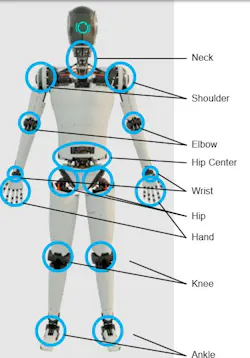
Humanoid robots are becoming more complex and precise, boasting a higher number of degrees of freedom (DOF) and an AI-powered central compute engine. Modern humanoid robots incorporate up to 70 DOF to achieve human-like dexterity and mobility, an increase from the six to 12 DOF typically found in industrial robotic arms. They are now capable of assessing, adapting and responding to the surrounding environment within milliseconds.
Having more DOF in a system requires more electric motor drives, with the location of the motor drive defining the various requirements to support it.
The actuators in a humanoid robot must receive motor position data to define the path planning to control motion. To achieve controlled movement with high precision, the robot must have rotor position sensors to capture information at the motor and the ability to efficiently pass information through the motor drive to the centralized processing computer.
Compact motor drivers—such as gallium nitride (GaN) power stages—reduce size and heat in tight joints, while batteries and capacitors support runtime and energy recovery.
The Power Stage defines efficiency, thermal performance and power density. Inefficient power stage design leads to excessive heat, reduced battery life and bulky actuators. Power levels in a humanoid robot can vary from 4kW to 10W, with most of the drives between 10W and 1.5kW depending on the drive location of the robot.
Humanoid robots use algorithms to process sensor input for obstacle detection, path planning and precise movement for autonomous navigation of complex environments. Motor control algorithms determine torque ripple, efficiency, acoustic noise and dynamic response. Advanced algorithms also enable higher performance from the same hardware.
TI has many different MCUs that fit algorithm and angle sensor requirements for humanoid robots, as well as C2000 real-time microcontrollers and Arm-based microcontrollers used in motor control algorithms.
Explore key motor-drive design considerations for humanoid robots, from position and current sensing to power-stage efficiency and functional safety. Learn how integrated motor-control technologies help engineers achieve precise, responsive motion across robotic joints and actuators..
Simplify Humanoid Robot Connectivity with Ethernet
Texas Instruments’ Ethernet portfolio addresses communication challenges in humanoid robotics by enabling higher bandwidth for increased data throughput, minimized latency for real-time deterministic communication, and reduced cabling for space and weight optimization.
An EtherCAT (Ethernet for Control Automation Technology) network is a high-speed, deterministic industrial Ethernet fieldbus (IEC 61158) designed for real-time machine control and automation. EtherCAT was Invented by Beckhoff Automation in 2003.
Texas Instruments supports real-time EtherCAT industrial Ethernet across several processor families, primarily for slave nodes in motor control, drives and industrial I/O, while enabling master (main device) implementations through third-party and open-source stacks.
Ethernet addresses the need for higher data throughput, lower latency, and smaller and lighter weight cables. Learn how Ethernet addresses critical communication challenges in humanoid robots, including bandwidth, latency and cabling complexity. Explore how Standard and Single-Pair Ethernet technologies support reliable, real-time data exchange between motor controllers, sensors and processing systems.
Helping Humanoids Hear and Speak
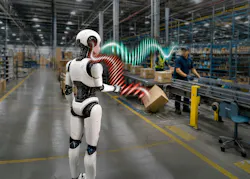
Factories, hospitals, homes and other environments for humanoid robots can be loud, cluttered and unpredictable. Enabling a robot to reliably hear commands and respond naturally is a difficult engineering challenge in robotics design. Still, advances in microphone arrays, beamforming and high-efficiency amplification are opening the door to audio interaction that feels less mechanical and more human.
Delivering all of these capabilities requires a complete audio signal chain, from microphone aggregation supporting analog and digital inputs to high-efficiency Class-D amplifiers that maximize output power without draining the battery.
Discover how advanced audio technologies enable humanoid robots to hear, interpret and respond to their surroundings. Investigate key design considerations for microphones, audio signal processing and speakers that help engineers develop more natural, reliable human-robot interactions.
Summary
Texas Instruments provides system‑level solutions for humanoid robots combining high-performance motor control, real-time communications and power conversion all working together to deliver precise and reliable robotic motion. Take advantage of TI’s interactive reference diagrams with subsystem product recommendations as well as its technical white papers and trending blog posts, all helping engineers increase productivity while meeting cost and performance requirements.
Related
About the Author
Related
 1920x1080humanid_hero

Voice Your Opinion!
To join the conversation, and become an exclusive member of Machine Design, create an account today!
 Leaders Logo
Leaders relevant to this article: