MD&M West 2026 Booth Briefing—SME Insights on Motion Solutions for Surgical Robotics
Key Highlights:
- Copley Controls introduced compact, high-power servo drives designed to meet the demanding space and power constraints of modern automation and robotics systems.
- OEMs are adopting automotive and defense design practices, including MIL-STD-810 standards, to enhance durability and reliability in mobile robots operating under shock, vibration and temperature extremes.
- Integrated motion solutions streamline development by combining motors, sensors and electronics into validated modules, reducing validation time and increasing system reliability.
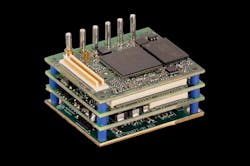
At MD&M West 2026, the focus at Copley Controls was on compact, power-dense servo drive platforms designed to address precision, efficiency and reliability challenges in modern automation and robotics. The company, which specializes in high-performance motion solutions for OEMs in life sciences, automated assembly, inspection and semiconductors, showcased its Nano and Nano Plus product families, including High-Power variants, with application examples relevant to AGV, AMR and surgical robotics.
The intent, noted Dean Crumlish, product manager and senior applications engineer at Analogic Copley Controls Corp. is to demonstrate “how small form-factor drives can deliver high current capability, high efficiency and robust operation in space- and power-constrained robotic systems.”
Editor’s Note: This Q&A is part of a series, Machine Design’s “Booth Briefings—SME Insights Shaping MedTech’s Future.” Conversations are centered on and sourced from MD&M West 2026, held at the Anaheim Convention Center in Anaheim, Calif. (Feb. 3-5, 2026).
Check out our full series of MD&M West 2026 Booth Briefings:
Q: In surgical robotics, what motion design factors most directly impact precision and compliance, and where do OEMs most often struggle?
A: Precision and compliance in surgical robotics are dominated by mechanical behavior between the motor and the end effector. Even systems marketed as zero-backlash introduce compliance through material deformation, stiction and hysteresis, particularly around zero speed and torque reversal. These effects distort force and position at the tool tip, directly degrading haptic fidelity.
OEMs most often struggle with:
- Compliance and hysteresis in gears, cables and transmissions
- Loss of haptic information due to mechanical filtering between surgeon and patient
- Motor cogging, which becomes significant at millinewton force levels unless low-cog motors or compensation techniques are used
- Sensing placement, where relying solely on motor-side feedback limits accuracy at the loadual-loop feedback—motor-side for commutation and speed, load-side for position and optionally force—is commonly used to mitigate these issues, but it increases system complexity and integration effort.
Q: For mobile robots, how are OEMs improving durability and power efficiency while meeting torque, shock-load and uptime requirements?

A: Mobile robot OEMs are increasingly borrowing from automotive and defense design practices to improve durability and reliability. This includes designing for shock and vibration, adding protective coatings and covers and extending operating temperature ranges for cold and warm storage environments. Validation to standards such as MIL-STD-810 helps identify and mitigate failure modes early.
On the power side, long runtimes from lithium batteries or ultracapacitors drive demand for very high-efficiency motion systems. Modern servo drives target efficiencies near 99% through optimized switching strategies and advanced power devices, while also addressing thermal management despite high current density. Safety is another core requirement. Certified Safe Torque Off (STO) functions are now expected to support collaborative and autonomous operation around people.
Q: What role do integrated motion solutions play in reducing validation effort, improving reliability and shortening time to market?
A: Integrated motion solutions reduce OEM burden by collapsing motors, gearing, sensing, power electronics, and connectivity into validated building blocks. Examples include compact joint-level architectures (such as nano robot joints) and donut-style cobot joints with integrated feedback, power and communication paths.
For early development and prototyping, modular solutions like evaluation or “EZ” boards allow rapid setup and testing before committing to a custom OEM design. This approach:
- Reduces system-level validation and rework
- Improves reliability through pre-tested architectures
- Accelerates time to market by letting OEMs focus on application-level differentiation rather than low-level motion integration
About the Author
 Rehana Begg
Rehana Begg
Editor-in-Chief, Machine Design
As Machine Design’s content lead, Rehana Begg is tasked with elevating the voice of the design and multi-disciplinary engineer in the face of digital transformation and engineering innovation. Begg has more than 24 years of editorial experience and has spent the past decade in the trenches of industrial manufacturing, focusing on new technologies, manufacturing innovation and business. Her B2B career has taken her from corporate boardrooms to plant floors and underground mining stopes, covering everything from automation & IIoT, robotics, mechanical design and additive manufacturing to plant operations, maintenance, reliability and continuous improvement. Begg holds an MBA, a Master of Journalism degree, and a BA (Hons.) in Political Science. She is committed to lifelong learning and feeds her passion for innovation in publishing, transparent science and clear communication by attending relevant conferences and seminars/workshops.
Follow Rehana Begg via the following social media handles:
LinkedIn: @rehanabegg and @MachineDesign
YouTube: @MachineDesign-EBM
Voice Your Opinion!
To join the conversation, and become an exclusive member of Machine Design, create an account today!
 Leaders Logo
Leaders relevant to this article: