MIT-Developed VLA Framework Cuts Robot Execution Latency by 11 Times
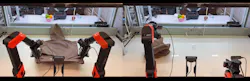
Researchers at MIT announced the development of a novel physical AI method that reduces the reaction latency of Vision Language Action (VLA) inference models by up to 11.8 times, but maintains high-precision, the researchers say. Called VLASH, the physical AI approach allows VLA models, such as Physical Intelligence’s Pi Zero (π0.5) and NVIDIA’s Gr00t, to perform high-speed, high-precision tasks such a playing Ping Pong or Whack-a-Mole.
For context, VLA models, while prized for enabling a wide range of robotic applications without requiring task-specific training, can suffer from sluggish performance. This is due, the researchers detail in a recent research paper, to the synchronous inference paradigm of foundational VLA models.
In essence, VLA models function in a series of stages. First, sensors perceive the environment and robot state which serves as the input for the inference step for the task at hand. That calculation then informs the commands sent to robot to execute an action “chunk.”
Since these stages happen in sequence, each action chunk is delayed until the next inference processing stage completes. Since a synchronous VLA model can’t perceive or perform inference during an action stage, the result is often halting, stop-and-go robot movement.
There is a way to address this limitation, the researchers acknowledge, called asynchronous inference. Namely, the action and inference stages execute simultaneously; while the robot is executing the first action chunk, inference for the second action is processed at the same time, thereby reducing latency. However, the MIT researchers state this “naive asynchronous” approach introduces a new difficulty while solving the initial one.
The problem is that the second inference stage bases its calculations on a robot/environment state that is “stale” or existed prior to robot’s position changing due to execution of the current action chunk. As a result, a mismatch, or “temporal misalignment” as the researchers put it, can occur. While the inference stage being processed may match the environment state as it was, it doesn’t match the environment state as it is or will be.
VLASH, therefore, is an VLA method that purports to retain the performance gain of asynchronous inference without incurring the penalty. According to the researchers, it accomplishes this by, to borrow a hockey coach adage, skating to where the puck will be, not where it is. In essence, VLASH uses the trajectory calculated for the current action chunk to predict the robot state as it will be in the near future and then bases the concurrent inference stage on that future state prediction.
The result, the MIT researchers write, is “a general asynchronous inference framework for VLAs that achieves smooth, accurate, and fast reaction control without architectural changes or additional runtime overhead.”
Lead author of the research paper, Song Han, is an MIT associate professor in the Department of Electrical Engineering and Computer Science (EECS), along with co-lead authors, MIT EECS graduate student Jiaming Tang and Tsinghua University student, Yufei Sun, with contributions from researchers at NVIDIA, University of California at Berkeley, University of California at San Diego and Caltech.
For a deeper dive on VLASH and VLA inference models, check out the research paper online and VLASH code repository on github.
About the Author
 Mike McLeod
Mike McLeod
Senior Editor, Machine Design
Mike McLeod, senior editor of Machine Design, is an award-winning business and technology writer with more than 25 years of experience. He has covered the full spectrum of mechanical engineering, from industrial automation, aerospace and automotive, to CAD/CAE, additive manufacturing, linear motion and fluid power.
Voice Your Opinion!
To join the conversation, and become an exclusive member of Machine Design, create an account today!
 Leaders Logo
Leaders relevant to this article: