Adaptive Motion Systems: Building Machines That Learn

Just when engineers thought they had mastered tuning parameters and torque curves, along comes AI-driven motion systems to rewrite the rules. Intelligent design tools and adaptive control algorithms have become part and parcel of how motion systems perform and how engineers learn, prototype and keep pace with progress.
Evaluating ROI in Humanoid Robotics: Don’t Believe the Hype
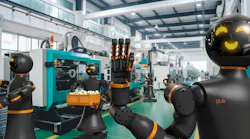
Look to humanoid robots as a case in point. We can view these highly sophisticated robots as machines with motion systems integrated with control, perception and autonomy. Judging by recent progress, we seem to have reached a tipping point where system-level advancements in actuators, compliant structures and AI-driven control are forging new capabilities and reliability. And with prices dropping below $50K and performance approaching practical industrial use, we are witnessing an uptick in task-specific automation in unstructured environments.
Despite the impressive data and bold claims by major humanoid players, Machine Design Senior Editor Mike McLeod proceeds with caution. What happens when you scrutinize the data underpinning these promises? That question frames our headline story.
Deep Domain Expertise in the Era of Intelligent Motion and Control
In this eBook, we further examine motion systems not as concepts, but as operational decisions. That suppliers are asked to deliver fully integrated motion solutions, not just components, is a natural consequence of shifting demands across automation. A motion platform no longer arrives as a box of components but shows up as ready-made intelligence, designed to plug into complex machines and start thinking, moving and adapting from day one.
For design engineers, this shift is a prompt to rearchitect from the outset. They treat performance as the outcome of harmonizing computational demands, deterministic networks such as EtherCAT and tight hardware-software coupling.
Bell-Everman's Michael Everman defines motion systems as “a conglomeration of our standard single-axis products put into multi-axis subsystems that become a drop-in to a larger system for an OEM or an integrator.” He also notes that with edge AI and embedded intelligence reshaping motion systems, they’re evolving into proactive platforms that self-tune through machine learning and physics-informed simulations. (Watch the video to hear Michael Everman’s take.)
Also championing the holistic systems view are experts like Tolomatic’s Mason Cousins and John Fenske. Cousins says making sure an actuator delivers the right force and speed is table stakes. But he adds that real success depends on anticipating downstream challenges in tuning, latency, vibration damping and safety integration before systems make it to the factory floor.
From Automation Platforms to Ultra-Heavy Payloads
Contributing editor Treena Hein explores the shift from hydraulic to electric drives and the control architectures that enable high stability, accuracy and safety in dynamic applications such as pallet transport and terrain navigation. Her examples highlight the mechanical and electronic coordination driving movement and stability in advanced robotic and lifting systems.
Then, shifting the focus to ultra‑heavy automation, a submission from Güdel shows how motion‑system design assumptions are being overhauled in industries such as aerospace, automotive, energy systems and heavy fabrication. This development has reprioritized the core engineering assumptions underpinning motion‑system design. In this new reality, torque‑to‑inertia ratios, closed‑loop bandwidth and dynamic stiffness influence performance as much as mechanical layout choices.
Catch the extended lineup of stories and expert perspectives on our Motion Systems Takeover Week hub.
As always, your feedback is invaluable. Reach us at [email protected].
Rehana Begg, Editor-in-Chief, Machine Design
Stay Ahead in Motion Systems: Recap of Takeover Week Highlights





 Transverse-flux motors thumbnail.
 Mark Perkins, senior design engineer, Winsmith.
 Motion Plastics in Cleanroom Design
About the Author
 Rehana Begg
Rehana Begg
Editor-in-Chief, Machine Design
As Machine Design’s content lead, Rehana Begg is tasked with elevating the voice of the design and multi-disciplinary engineer in the face of digital transformation and engineering innovation. Begg has more than 24 years of editorial experience and has spent the past decade in the trenches of industrial manufacturing, focusing on new technologies, manufacturing innovation and business. Her B2B career has taken her from corporate boardrooms to plant floors and underground mining stopes, covering everything from automation & IIoT, robotics, mechanical design and additive manufacturing to plant operations, maintenance, reliability and continuous improvement. Begg holds an MBA, a Master of Journalism degree, and a BA (Hons.) in Political Science. She is committed to lifelong learning and feeds her passion for innovation in publishing, transparent science and clear communication by attending relevant conferences and seminars/workshops.
Follow Rehana Begg via the following social media handles:
LinkedIn: @rehanabegg and @MachineDesign
YouTube: @MachineDesign-EBM
Voice Your Opinion!
To join the conversation, and become an exclusive member of Machine Design, create an account today!
 Leaders Logo
Leaders relevant to this article: