Universal Robots Launches Gen 7 Platform for AI-Ready Industrial Automation
Click here for more IMTS 2026 coverage.
Universal Robots (UR) has introduced its seventh-generation collaborative robot platform, Gen 7, with a redesigned architecture aimed at connecting AI, sensing and industrial automation more directly at the machine.
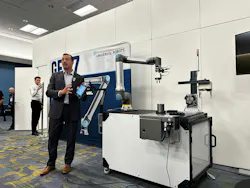
Launched Sept. 14 at IMTS 2026 in Chicago, Gen 7 includes three new g-Series robot arms, a new tool flange, CB7 Core controller, TP7 Core teach pendant, SP7 Smart Panel and PolyScope X software. Rather than treating AI as an add-on to a conventional cobot, UR, part of Teradyne Robotics, has redesigned the platform around the connectivity, compute and sensing requirements of physical AI.
READ MORE: igus Highlights Open Automation Ecosystem at IMTS 2026
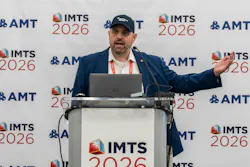
“We’re not talking about a single robot,” Will Healy III, Director of Product & Industry Marketing, Teradyne Robotics, said during the launch. “We’re really talking about a complete, unified…industrial automation platform.”
Gen 7 is built around that distinction. Healy told the press that the platform builds on more than 20 years of development and more than 100,000 deployments, incorporating feedback from customers as AI moves from experimental applications toward production environments.
Putting Connectivity at the Tool
The most visible change is the g-Series robot arm, but some of the more significant engineering changes are at either end of the system. Three new arms—the UR10g-1750, UR17g-1300 and UR18g-950—are named for their payload and reach, a change intended to make model selection more straightforward.
According to Healy, a common customer request has been a simpler way to identify key robot specifications during product selection. In response, the company added reach to its part-number nomenclature alongside payload. “They said, ’For the love, put the reach in the part number,’” Healy said. “If you’re familiar with UR part numbers in the past, it was just the payload. And if you know robotics, there’s the holy triumvirate of robotics. As Bob Rochelle from Google, who’s retired now, always says: reach, speed and payload. Putting payload and reach into our part numbers was important for customers.”
Healy said AI adoption is accelerating the convergence of operational technology (OT) and information technology (IT), making secure connectivity a growing requirement for industrial automation. Rather than isolating robots from enterprise networks, manufacturers increasingly need systems that can securely exchange data between workcells, peripherals and higher-level software platforms.
READ MORE: Q&A: Robco on Robotics-as-a-Service and the Move Toward Physical AI
“If we’re going to be a place where people land our AI, we need to be a modern and mature IT partner for the IT department,” he explained. “It’s no longer OT versus IT. We’re all part of the IT infrastructure.”
To this end, the new tool flange is designed to get data and power to increasingly sophisticated end-of-arm tooling. The flange provides Ethernet, power and configurable I/O at the tool, allowing cameras and high-bandwidth sensors to connect closer to the point of operation.
UR also has integrated force-torque sensing, impedance control and RTDE (Real-Time Data Exchange) capabilities for applications such as dexterous manipulation and force-sensitive assembly, according to aUR's press notes. “The devices at the end of the robot are having to be much smarter,” Healy reinforced.
Christopher Savoia, Global Head of UR+ Ecosystem, Universal Robots, pointed to another consequence of the architecture. “Naked robots don’t do anything,” he said, describing the role of vision, gripping, welding, inspection, material handling and AI partners in turning the robot platform into an application. The higher-power tool connection and integrated Ethernet are intended to reduce cabling and simplify integration for those technologies, Savoia noted.
More Compute, More Network Access
The controller is another major Gen 7 redesign. The CB7 Core delivers 40% more compute power while occupying a smaller footprint than the previous generation, according to UR. It includes three 1-Gb Ethernet ports and configurable I/O for direct communication with systems such as PLCs, HMIs, MES platforms, industrial PCs and vision systems.
That connectivity highlights a change in how UR sees the robot’s role within the factory. “In the past, the general rule of thumb was, ‘Don’t put your automation on your network,’” Healy reminded the audience. With AI applications requiring more communication between robots, cameras, computing resources and factory systems, he argued that automation today needs to operate as part of the overall IT infrastructure.
“We’re all part of the IT infrastructure,” he said. The controller is in his view intended to support multiple network layers while maintaining cybersecurity and industrial safety requirements.
Software Becomes Part of the Platform
PolyScope X provides the software foundation for Gen 7, with an open API and built-in ROS 2 communication. An API, or application programming interface, defines how software systems communicate with one another, while ROS 2 provides the open-source middleware and developer tools for building complex robot applications. Together, they allow developers to connect external AI processing and industrial computing to the robot.
The approach also serves to extend UR’s established partner ecosystem. Savoia said Gen 7 remains compatible with UR+ technologies while giving partners more connectivity and compute capabilities to work with. For manufacturers, the goal is naturally to avoid rebuilding the automation architecture each time a new AI-enabled tool or application is introduced.

AI-Ready, Without Abandoning Usability
Despite the emphasis on AI, UR is not positioning Gen 7 solely for manufacturers already deploying physical AI. Healy described the platform as a way for customers to become “AI ready” even if they are not deploying AI today. The idea is to give manufacturers an architecture capable of supporting future applications without requiring them to replace the underlying automation platform.
Ease of use remains a core focus. The TP7 Core teach pendant has been redesigned with ergonomics and operator interaction in mind, while the new SP7 Smart Panel brings robot controls and maneuvering functions closer to the application. According to UR, the TP7 Core is more than 20% lighter than previous generations and introduces features such as configurable buttons and a virtual joystick.
Overall, these updates are intended to support more advanced applications without significantly increasing the complexity of robot setup or programming.
For Keith Fox, Vice President, Product Management, Universal Robots, that expanded architecture is the point. “Manufacturers are no longer asking whether Physical AI will matter,” he said. “They’re asking how to deploy it safely, reliably and at scale.”
The platform’s emphasis on deployment was also evident across IMTS, with Gen 7 demonstrations at more than 20 partners’ booths, including Cognex, Schunk, Magswitch, Smooth Robotics, Psyonic, Robotiq and Inbolt.
The integrations point to UR’s vision of a “destination platform for physical AI”—an open execution layer designed to move AI applications from development into industrial applications. In that sense, Gen 7 expands the role of the robot arm beyond motion, tying together sensing, compute, software and the industrial systems needed to deploy AI-enabled applications on the factory floor.
As Fox summarized, “AI-driven industrial automation is ready to move into production.”
About the Author
 Rehana Begg
Rehana Begg
Editor-in-Chief, Machine Design
As Machine Design’s content lead, Rehana Begg is tasked with elevating the voice of the design and multi-disciplinary engineer in the face of digital transformation and engineering innovation. Begg has more than 24 years of editorial experience and has spent the past decade in the trenches of industrial manufacturing, focusing on new technologies, manufacturing innovation and business. Her B2B career has taken her from corporate boardrooms to plant floors and underground mining stopes, covering everything from automation & IIoT, robotics, mechanical design and additive manufacturing to plant operations, maintenance, reliability and continuous improvement. Begg holds an MBA, a Master of Journalism degree, and a BA (Hons.) in Political Science. She is committed to lifelong learning and feeds her passion for innovation in publishing, transparent science and clear communication by attending relevant conferences and seminars/workshops.
Follow Rehana Begg via the following social media handles:
LinkedIn: @rehanabegg and @MachineDesign
YouTube: @MachineDesign-EBM
Voice Your Opinion!
To join the conversation, and become an exclusive member of Machine Design, create an account today!
 Leaders Logo
Leaders relevant to this article: