Q&A: Designing Industrial Chargers for Multiple Battery Chemistries

Industrial equipment manufacturers have to account for a wide range of battery technologies and charging requirements in the equipment they design. Customers may be operating lead acid and lithium-ion batteries across mixed fleets, using different vehicle types and chargers, while keeping an eye on chemistries such as sodium-ion that could introduce new requirements. For OEMs, the challenge is accommodating that diversity while leaving room for changes in battery technology, fleet configuration and charging needs.
These demands raise some important engineering questions: How much voltage flexibility should a charger offer? What makes a power architecture modular enough to accommodate a growing or changing fleet? How should OEMs approach battery communication, thermal management and physical integration when future battery technologies may bring different demands?
Anton Clark, Senior Product Strategy Manager at Enatel, keeps a close eye on how changes in technology, customer needs and regulatory requirements are influencing industrial charging. His role brings these developments together, helping shape product strategies around the practical demands facing customers.
Enatel is a global charging infrastructure company with more than 20 years of experience in power conversion and battery charging. Its industrial charging systems serve applications ranging from material handling and ground support equipment to automated guided vehicles. In the following Q&A, Clark discusses the implications of battery diversity for equipment OEMs and the design decisions involved in developing charging systems that can adapt.
Machine Design: Many industrial fleets are becoming a mix of lead acid and lithium-ion, with sodium-ion and other chemistries on the horizon. How should OEMs approach charging infrastructure today, so they aren’t designing themselves into a corner five or 10 years from now?
Anton Clark: There are three design elements OEMs should consider. Voltage is the first since a diversified voltage mix is likely on the horizon. We’re seeing that the industry is continuing to increase to higher-power charging, and higher voltage is an effective way to get there while keeping charge currents manageable.
The second is a flexible controller. The last generation of charging products had no capability of charging anything but lead acid. It was built purely as a lead acid charger and was not a particularly flexible controller. OEMs should look for current-generation chargers that are built to be extremely flexible and that can be updated throughout its life to match changes in the market. That kind of charger can respond to shifts like sodium-ion, solid-state and other innovations not yet imagined.
READ MORE: Power Continuity: Sustaining Critical Operations in a Connected World
The third is flexible power conversion. OEMs might anticipate changes in voltages, chemistries and profiles and have a controller to deal with those shifts, but they need the power conversion to back it up, too. That means utilizing power conversion with a wide output range, ideally with the charger producing nearly full power across that range.
MD: Supporting battery systems from 24V to 96V—and potentially multiple vehicle platforms—from a single charging architecture sounds attractive. What are the biggest engineering tradeoffs in designing for that level of voltage flexibility?
AC: For OEMs building equipment that will operate across multiple voltages, the key engineering consideration is finding a charging partner whose architecture supports the full range. That kind of flexibility requires innovation and modern topologies from the charger manufacturer. Chargers built on older single-voltage designs may work well in isolation, but they lock OEMs into a specific charger type as their vehicle lineup expands.
The tradeoff worth thinking through is the balance between flexibility and specialization. A charger designed for a wide voltage range and multiple chemistries requires specialized engineering, which can carry a higher upfront cost than a single-purpose charger. For OEMs planning to serve customers whose fleets will evolve over the next five to 10 years, such as moving to higher voltages, adopting new chemistries or running mixed fleets, that flexibility becomes the foundation for a competitive product roadmap.
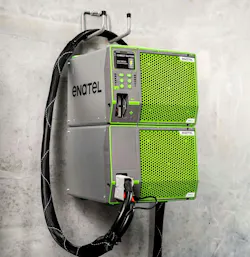
MD: Modular power architectures are often positioned as a way to scale charging capacity as fleets grow. From a system design perspective, what separates a truly modular architecture from one that is simply expandable? What design pitfalls do OEMs need to avoid?
AC: A true modular charger is made up of a lower SKU count set of parts that are interchangeable with each other and can be reconfigured with little effort. For example, changing a charger’s AC supply type or its output power should be a quick job that requires minimal or no tools. That largely separates a modular charger from one that is only expandable: a modular charger can be changed in purpose, not just scaled in capacity.
There are two considerations OEMs should weigh. The first is upfront cost. Modular chargers generally carry a higher price tag than fixed-purpose designs due to the extra parts and level of engineering required to make the architecture flexible. But for OEMs evaluating options, the upfront cost is offset over the equipment lifecycle. A modular charger means fewer product variants to design around and a longer usable life as the customers’ fleets evolve.
The second consideration is reliability and avoiding future failure points. Modularity can make the charger more flexible but less reliable if it isn’t engineered properly. For example, many manufacturers have unintentionally created backplane systems with issues in the effort to make chargers modular. When evaluating a charging partner, OEMs should investigate how modularity was implemented at the design level.
MD: As battery chemistries evolve, charging profiles, communication protocols and thermal requirements also change. Which aspects of charger design can be future-proofed through software, and which hardware decisions must OEM engineers get right from the beginning?
AC: Charging profiles and communication protocols can both be future-proofed on the software side through controller flexibility. A well-designed controller can accommodate evolving charge profiles and multiple communication protocols as the market shifts.
On the hardware side, communication interfaces need to be future-proofed during the design phase. Interfaces such as CAN bus have to be designed from the beginning to some extent, but expansion boards can help extend that flexibility. Engineers can also modularize controllers by keeping the same core controller and adding interfaces as needs change and the industry evolves.
Thermal requirements are also important. The main way to handle changing thermal needs is by improving efficiency. Enatel's current-generation charger was designed to be compact and power-dense. The only way it can be that compact and power-dense without running too hot is by being highly efficient (>95%). An inefficient charger (<85%) creates excess heat, so effective thermal design starts by minimizing that waste.
MD: Historically, engineers optimized individual chargers. Increasingly, the optimization target is the entire fleet. How does this shift change the way OEMs should think about charging architecture, energy management and system integration?
AC: On the architecture side, the range of chargers a manufacturer carries stock for and trains their technicians to service shrinks, which results in operational efficiency.
Site design and the layout of chargers in a facility is another way architecture is impacted by this shift. An old architecture might have had distinct bays for each vehicle type, whereas now OEMs can have a flexible set of charging bays with chargers fit for different vehicle types. With a flexible charger, OEMs can install a set of park-and-charge bays that will be ready for a wide range of voltages.
READ MORE: Fully Charged: Breakthroughs in Lithium-ion Battery Materials
In the future, there may be more potential peak load from battery charging than there is available AC infrastructure. A charger with a more complex controller can be ready to meet those challenges.
System integration will be key for energy management. It will be important for OEMs to have chargers that integrate with and have knowledge of other energy loads in the building. For example, a facility with refrigerated storage with varying loads may need to prioritize cooling on a hot day, limiting charging to keep the facility from drawing excess power and being penalized by a utility.
MD: Higher power densities and faster charging place greater demands on thermal management and serviceability. What mechanical design considerations (such as enclosure layout, airflow, cooling strategies and field access) have become more important as charging systems become more capable?
AC: While assuming that higher power densities would create greater thermal demands makes sense on paper, that is not always the case. As charger power density has increased, inefficiency has decreased in tandem, which reduces the amount of waste heat that needs to be managed.
Techniques for heat dissipation, however, have changed significantly. Charger construction has moved from through-hole components bolted to heat sinks, or bolt-on scale components, down to surface-mount PCB scale with different cooling designs. Often, dedicated heat sinks are not required at all, and direct air cooling of packages in high-efficiency use cases is sufficient.
MD: Many industrial sites are discovering that available electrical infrastructure—not battery technology—is becoming the limiting factor. How should OEMs design charging systems when grid capacity, peak demand and energy management become part of the engineering equation?
AC: As grid capacity increasingly limits industrial operations, OEMs should prioritize chargers with feature-rich controllers that can independently enforce group power limits or integrate with a system controller. This capability enables sites to manage total charging load against available AC infrastructure without adding operational complexity.
Sites should also think about operational strategies like staggering breaks and spreading charging over time, especially during high-power fast charging periods. Those operational changes work well until the site gets busier than anticipated. Group power limits can act as a backstop in those moments, ensuring that even when more charging happens at once than planned, nothing breaks.
The reverse consideration matters, too. Even sites with adequate grid capacity to run all chargers simultaneously may see financial rewards from reducing peak power usage. Whether that is saving on building infrastructure costs or reducing utility charges where utilities bill based on peak power use.
MD: Looking ahead, what design assumptions about industrial charging should OEM engineers challenge today? What aspects of charging infrastructure are changing fast enough that designing around today's requirements alone could become a competitive disadvantage?
AC: The biggest assumption OEM engineers should challenge is that a charger's feature set at the time of purchase is what they are stuck with for the life of the charger. That is no longer true. If an OEM buys a charger anticipating lead acid and lithium-ion, a modern charger should be able to adapt to future needs, such as charging sodium-ion down the line or working with a new building management system as facilities evolve. A flexible controller can have a feature set that grows with the application over its life.
Battery types and voltages also warrant attention. Lead acid was the industry standard for a long time and remained stable, until lithium-ion entered and disrupted both how batteries are charged and the patterns they’re charged in. Those shifts will continue, and OEMs designing infrastructure now can be reactive to them.
MD: As charging systems become more connected and software-driven, are we seeing a shift where the charger becomes less of a power conversion device and more of an intelligent edge component within the industrial ecosystem?
AC: Yes. Historically, chargers were simple devices with some magnetics, a couple of passive components and a timer to stop the charge. The industry is now moving toward a future where operators want intelligence in how they charge.
Modern chargers should be able to provide real-time visibility into battery health and state of charge, surface predictive maintenance signals before equipment fails, integrate with battery management systems across chemistries, and coordinate with facility-level energy system management to optimize load timing. Chargers are becoming the intelligent link between the energy available on a site and the energy needed to keep industrial equipment running.
For OEMs, the charger integrated into their equipment is becoming an increasingly important source of data and a point of coordination with other systems. The biggest driver behind this change is that it has almost developed its own demand. As operators have seen what’s possible, they want to be able to do it. As material handling has evolved, the drive to optimize infrastructure and extract every bit of value from it has grown alongside.
Have a question, comment or idea? Get in touch with the Machine Design editors at [email protected].
About the Author
 Rehana Begg
Editor-in-Chief, Machine Design
As Machine Design’s content lead, Rehana Begg is tasked with elevating the voice of the design and multi-disciplinary engineer in the face of digital transformation and engineering innovation. Begg has more than 24 years of editorial experience and has spent the past decade in the trenches of industrial manufacturing, focusing on new technologies, manufacturing innovation and business. Her B2B career has taken her from corporate boardrooms to plant floors and underground mining stopes, covering everything from automation & IIoT, robotics, mechanical design and additive manufacturing to plant operations, maintenance, reliability and continuous improvement. Begg holds an MBA, a Master of Journalism degree, and a BA (Hons.) in Political Science. She is committed to lifelong learning and feeds her passion for innovation in publishing, transparent science and clear communication by attending relevant conferences and seminars/workshops.
Follow Rehana Begg via the following social media handles:
LinkedIn: @rehanabegg and @MachineDesign
YouTube: @MachineDesign-EBM
Related




Voice Your Opinion!
To join the conversation, and become an exclusive member of Machine Design, create an account today!
 Leaders Logo
Leaders relevant to this article: