How Augmented Reality is Changing the Way We Design Machines
Every machine is built twice, the first time digitally and the second time in its physical form. The success of every program depends on how closely those two versions stay aligned. That sounds obvious, but it is one of the biggest challenges in manufacturing today.
Designers, engineers, manufacturing teams, compliance specialists, suppliers and executives all contribute to bringing a product to life. Every group has a different perspective, different priorities and often different tools. This is where the main challenge lies. Not in ideas, but in the difficulty of ensuring and preserving a shared product vision, before expensive decisions are made.
For decades we have relied on drawings, CAD models, renderings and eventually physical prototypes to bridge that gap; each step improves understanding, but it also introduces interpretation and this brings risk. Any misinterpretation costs time, money and—in many cases—compromises design intent.
This is why physical prototypes have historically been so important. When design, engineering, manufacturing and leadership can stand around the same object, misunderstandings disappear, challenges with form arise and engineering constraints become real. Decisions become faster, clearer and more informed before committing to production tooling that may cost millions.
The obvious question for years has been whether that same level of confidence could be achieved earlier, before the physical prototype is built. The recent maturity of spatial computing, specifically augmented reality, suggests that the answer is yes.
How AR is Being Used Today
Augmented reality (AR) as a tool used in the product design and development process has been rather immune to the hype cycle, and that is unlikely to change. But what we are seeing is a stable increase in its adoption. This is partly due to improved hardware and software—today’s headsets come with front-facing color cameras and in-built depth sensors on headsets, which provide a high-definition AR experience and unlock new ways of communicating and experiencing the work. And even as project budgets come under pressure, the cost of these devices has reduced to the point where it is negligible compared to the value a team gains.
AR has moved long past the experimental phase, becoming a valuable, practical and reliable tool that enables clear and conscious design decisions and drives confidence amongst all stakeholders. It’s currently most aggressively used to visualize digital 3D data at scale, in context, in relation to real-world constraints and ergonomic factors. This capability enables design engineers to build visual confirmation from static assets, rather than solely relying on expensive physical prototypes.
This is particularly important in the automotive sector, given the huge costs associated with physical prototypes. A single fullscale clay model can represent hundreds of thousands of dollars once milling, logistics, contractors, scanning and refinement are considered. Multiple clay models may be produced during the development of a single vehicle program, simply because they provide something that digital tools have historically struggled to deliver: shared spatial confidence.
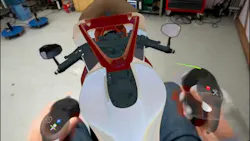
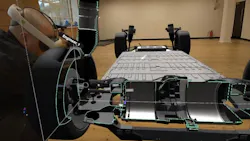
AR is now being used to establish the direct relationship between a physical asset and its digital counterpart. For example, design teams are placing digital design data on top of an established chassis. Matching the raw engineering hardpoints with design data accelerates alignment between these teams and brings downstream stakeholder conversation forward.
It is also being used to compare previous generations of vehicles with the proposed next generation digitally at true scale. These teams are building visual confirmation much faster than the traditional process of staged development gates with physical assets, and this is reducing reliance on clay models, as well as ensuring teams get the most value out of the prototypes they do build.
This exploration of AR in the design workflow is not slowing down anytime soon.
What’s New
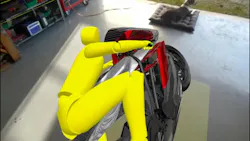
One of the most interesting developments we've seen over the past year hasn't come from industrial design but from engineering teams. Cable harnessing and routing is a good example. Traditionally, routing electrical systems is a detailed engineering exercise that happens once much of the product architecture has already been defined. Engineers work inside specialist software to resolve collisions, accommodate movement, satisfy serviceability requirements and ensure the machine can actually be assembled and maintained.
Increasingly, we’re seeing teams use AR much earlier in that process. Instead of waiting until every component has been fully modelled, engineers are standing alongside physical machines and rapidly exploring routing concepts in context. They can visualize cable paths around existing equipment, understand how assemblies move through their range of motion, evaluate service access and identify potential clashes long before detailed engineering begins.
The value isn't that AR replaces engineering software—it doesn't. The value is that engineers arrive in those specialist tools having already solved many of the spatial problems that traditionally consume time downstream. We'll continue to see this pattern emerge across engineering. The most interesting spatial workflows won't come from software companies inventing new features, they'll come from engineers applying spatial computing to problems they've been solving for decades.
Better Decision Making
With AR, teams aren’t necessarily producing better visualizations; they are making better decisions earlier because it allows many of the cross-functional conversations needed to bring a product to life to happen simultaneously.
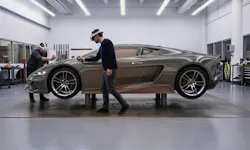
Transportation teams are overlaying digital design proposals directly onto physical chassis and clay models to understand proportion before another physical model is milled. Motorcycle manufacturers are evaluating multiple tank and fairing designs against an existing vehicle without physically prototyping each option. Increasingly, digital and physical development are happening in parallel instead of one after the other.
This is where the machine and manufacturing industry has a huge opportunity to change processes and workflows and push for more radical adoption of spatial computing. And it is already starting to happen. In early-adopting organizations, engineering and manufacturing voices are being heard earlier. This is resulting in products coming to market faster and more thoughtful approaches to sustainability and compliance without compromise.
Building Sustainable and Compliant Machines
The sustainability of the products we build is increasingly under scrutiny. It is a key focus for any product development team. Every product team wants to deliver a sustainable product that will stand the test of time.
Sustainability goes beyond the stereotypes of recycled materials and encompasses a wide spectrum that includes design, manufacturing processes, serviceability and time-to-market. Adopting AR in the early stages of product development ensures a level of alignment and inclusivity that can smoke out most complications that can arise in the development, delivery, serviceability and end of life-cycle of a product.
Compliance with safety and security standards is crucial and these standards are changing all the time. By using AR to bring these considerations in earlier on in the design process, teams can actively design the shape of the machine around clear constraints, which will allow them to meet standards while maintaining the overall aesthetic and design direction. This is especially important for the automotive industry as we often buy cars for the way they look, ahead of performance and functionality.
Put simply, AR can help teams anticipate and adapt to changing standards and directional shifts the company may make, making the design and engineering process more efficient and less prone to costly compromises.
The Future
For years, mobile device based augmented reality promised to help build spatial understanding and alignment. The problem, however, was that the experience itself was limiting. Viewing digital content through a phone or tablet improved visualization, but it rarely transformed engineering workflows because users were still interacting through a flat display rather than experiencing information in the context of physical space.
Viewing digital content through a phone or tablet never fundamentally changed the workflow because people were still looking through a flat screen; humans understand proportion, distance and ergonomics through stereoscopic vision. Humans understand spatial relationships through a combination of visual depth cues, motion, scale and physical interaction—not through a single flat representation.
The arrival of high-resolution passthrough spatial computing devices such as Meta Quest Pro, Meta Quest 3 and Apple Vision Pro represents an important turning point; for the first time, teams can remain grounded in their physical environment while viewing digital information with convincing depth and scale. The technology has quietly crossed an important threshold. Instead of escaping reality, we can now merge it with digital content, spatially.
Physical prototypes are not disappearing anytime soon. There is still no digital substitute for touching a product, operating a machine or observing how people physically interact with something in the real world. What will change is when spatial confidence is established. This will increasingly be built before the commitment to develop physical prototypes.
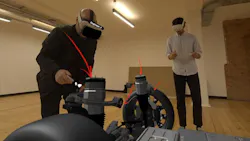
We are already seeing companies dedicate permanent spaces inside their studios where digital twins remain available for continuous review. Teams walk through these spaces, put on a headset and immediately see the latest state of a program at full scale or a series of digital markups overlayed on top of physical properties indicating that work is in progress.
The conversation moves from presentations to presence, which feels like a much more natural way for humans to collaborate. For decades we have adapted ourselves to computers. Spatial computing represents one of the first serious attempts to adapt computing to the way humans naturally understand the world.
That is why AR is becoming far more than another visualization tool; it is becoming infrastructure for better decision making and better decisions are what ultimately build better products.
Editor’s Note: This article is part of Machine Design’s summer reading series exploring global design engineering trends redefining how products are conceived and scaled.
In This Series:
- From Data to Decisions: The Race to Make Industrial AI Operational
- The Coming Shift: Why Industry 5.0 Will Be Driven by AI in Mechanical
- Will AI Replace Programmers? What Elon Musk’s Prediction Means for Mechanical Engineers
- Q&A: The AI-Robotics Convergence: Global Perspectives for Machine Builders
- The Robots Are Getting Real: Lessons from Hannover Messe’s Industrial AI Reality
- How Augmented Reality is Changing the Way We Design Machines
About the Author
 Oluwaseyi Sosanya
Oluwaseyi Sosanya
Co-Founder and CEO, Gravity Sketch
Voice Your Opinion!
To join the conversation, and become an exclusive member of Machine Design, create an account today!
 Leaders Logo
Leaders relevant to this article: