The Robots Are Getting Real: Lessons from Hannover Messe’s Industrial AI Reality
If you want to see where industrial technology is headed next, Hannover Messe has long been the place to look. But this year felt different. Walking the halls of the German fairground in 2026, the prevailing conversation had shifted to where these technologies were already at work and which problems they were solving.
Beyond Isolated Pilots
There was evidence everywhere. Exhibitors emphasized AI-supported, production-ready applications that automate workflows and use machine intelligence to anticipate equipment failures. Physical AI emerged as a defining theme, extending intelligence from software into machines capable of sensing and acting in real time.
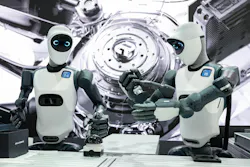
Humanoid robotics reflected a similar maturation, as Agile Robots focused on industrial deployment while Schaeffler’s Hermes Award-winning actuator platform demonstrated that scaling humanoid systems will require advances in mechanical engineering alongside AI. Energy innovations commanded equal prominence, underscoring that the transition to carbon-neutral industry depends on integrating power, automation and digital infrastructure.
The trade fair's changing tone, with greater emphasis on real-world industrial readiness, was echoed by Matthieu Kulezak, Senior Analyst, Interact Analysis, whose work forecasting the automation market positions him to distinguish lasting trends from short-lived hype. AI appears to be moving beyond the hype cycle and into a more mature phase of adoption, he said. Across the show floor, conversations increasingly centered on practical applications, customer case studies and measurable industrial outcomes rather than speculative possibilities.
1. Artificial Intelligence Has Found its Job
Regular attendees to Hannover Messe can attest to a familiar rhythm, where novel technologies—digital twins and predictive maintenance—occupy the spotlight, then settle into a mundane, business-as-usual cycle. That's not the case with AI. “There’s still a great deal of momentum, but we're also seeing real execution,” Kulezak said, noting that a growing number of customer case studies and production deployments points to a market in which AI tools are increasingly being applied to real industrial challenges, including bottlenecks, defects and downtime.
2. Humanoid Robots Have Mastered the Art of Being Seen
Bipedal robots struck a pose at every turn at Hannover Messe, but trade show visibility is no substitute for evidence of industrial readiness. Kulezak, who attended logistics-focused trade shows, including LogiMAT and MODEX, observed that humanoids were barely featured there. “I was genuinely surprised by how many humanoids were showcased at Hannover Messe,” he said. “Part of that is brand building. Companies want to establish themselves in what they believe will become an important market.”
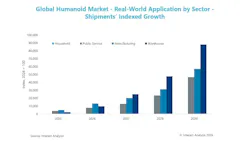
If relative near-invisibility at events closer to warehouse operations is a sign that humanoids are still building their brand and searching for their industrial foothold, then the underlying numbers still indicate serious long-term growth. Interact Analysis expects shipments of humanoid robots to top 700,000 units by 2032.
Kulezak cautions, however, that most of that volume will initially be driven by training and testing, rather than directly serving production lines. “Large-scale, real-world industrial applications remain limited; we’re still in the early adoption phase,” he said. In parallel, some manufacturers are rethinking whether the human form is necessary at all and exploring wheeled platforms that prioritize industrial efficiency over anthropomorphic design and charm.
3. A Supply Chain is Assembling Itself Around a Product That Barely Exists Yet
Whatever their form factor, humanoid robots depend on a broad upstream supply chain, from precision gear systems, compact actuators and machine-vision sensors to battery technology capable of powering a mobile machine through a full shift. Many of the companies that could supply these components are not robotics specialists at all. They are established manufacturers of motion control, sensing and energy storage and could pivot relatively quickly if humanoid demand materializes at scale.
Battery manufacturing is a case in point. Many manufacturers are already developing industrial vehicles such as forklifts that could be adapted for humanoid robot platforms. “We could see demand grow significantly in that area,” said Kulezak.
Another important component is gearing. “When we think about precision gearing, it sits at the center of humanoid robot development,” he said. “These systems require extremely high-precision gears, so companies that manufacture those components—particularly in regions such as Italy and Germany—are seeing increasing interest.”
For now, China stands out as the leader in humanoid robot assembly, even as the enabling components come from a supplier base that is scattered across Europe, North America and Asia. Kulezak expects that geography to adjust as the market ramps up, with the current supply chain acting as a starting point rather than a long-term blueprint.
4. The Control Cabinet Goes Virtual
Less visually dramatic, but no less significant, is the trend toward software-defined automation. The premise is simple: moving the intelligence that runs equipment from dedicated hardware into software, allowing functions traditionally performed by programmable logic controllers (PLCs) to run as virtual PLCs on general-purpose computing platforms.
The implications for hardware suppliers could be significant, said Kulezak, who likens the transition to the move from film to digital photography. This transition “could reshape competitive dynamics across the automation sector,” he said, adding that the transition will reward companies that are nimble enough to adapt and punish those that are not.
Kulezak noted that this year marked a turning point, with more companies moving from pilot projects to production deployments. One caveat, he added, is that the success stories highlighted at trade shows typically come from customers willing to speak publicly. The broader pace of adoption may be harder to gauge because many vendors point to customers who remain guarded about their system architectures, either because they are operating in stealth mode or protecting a competitive advantage as the market evolves.
Zoom out, however, and the industry is still in its early stages. “Manufacturing automation remains relatively early in its evolution,” Kulezak said. “Around the world, there is still significant manual labor and manual intervention.” The same is true of digitization, which, despite the buzz surrounding AI and Industry 4.0, has barely scratched the surface of its potential to improve processes and efficiency.
5. IT And OT Need to Talk to Each Other
Running through many of these developments—AI, robotics, software-defined automation—is the more basic and less exciting capability of getting the factory’s information technology (data systems and enterprise software) to communicate with operational technology (machines, sensors and controllers). Bringing these parallel systems together requires solving a practical challenge around data access and interoperability; system ownership and maintenance; communication between machines and software platforms; and integration of legacy equipment.
Kulezak pointed to OPC UA as an example of efforts to create a common communication framework across industrial systems. “The goal is to connect PLCs and control systems from many different vendors so machines can communicate using a common language,” Kulezak said. For meaningful AI-driven deployments, he said, plants need to solve the more basic integration problem first.
6. Signals of Rising Defense-Related Manufacturing Demand
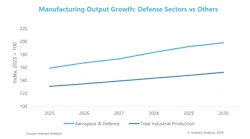
Defense, it turns out, is the trend hiding in plain sight—visible everywhere except the marketing materials. Forecasts show this trend extending through 2030 as upstream demand to metals, components and industrial capacity builds around defense and reindustrialization.
Kulezak is candid about why. Defense work is by nature confidential and the automation industry's biggest vendors prefer to trumpet their wins in more publicly palatable sectors such as food and beverage or chemicals. But scratch beneath the surface of vendor interviews and defense keeps surfacing as a live growth theme across Europe, extending across the entire supply chain.
At different trade shows, Kulezak has spoken with companies involved in building infrastructure, building management systems and even door manufacturing. “They all mentioned potential opportunities tied to defense-related projects,” he said.
More striking is how defense intersects with data centers—a market that automation vendors already understand well. As Kulezak noted, data center construction is a high-growth market. But the interesting question is how long that growth trajectory can continue. “There are only so many data centers required, so some of the strongest growth may already be behind us,” he said “Of course, markets are changing quickly, so it’s difficult to predict.”
Defense could plausibly extend that growth by driving demand for cooling, ventilation and environmental-control systems—areas where Europe’s automation vendors already offer deep expertise. Rather than requiring new capabilities, it creates new demand for existing ones.
Still, Kulezak resists overclaiming. While it remains unclear whether this will become a long-term trend or a shorter-term cycle lasting one or two years, defense spending tends to move with political winds rather than industrial ones. What is clear is that “vendors are increasingly viewing defense as a closely related growth opportunity,” noted Kulezak.
7. The Factories That Already Exist Win
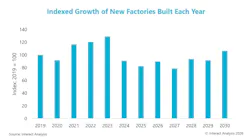
Although reshoring remains a major topic, most investment discussed at Hannover focused on expanding or modernizing existing facilities rather than building new factories. “That could mean adding another production shift, upgrading equipment or modernizing existing factories rather than building entirely new ones,” said Kulezak. “When we spoke with vendors, there was a significant difference from last year. Many said their business is focused primarily on existing facilities rather than completely new greenfield projects.”
Many manufacturers already have sufficient production capacity, while high interest rates, rising operating costs and the long-term risk of greenfield investments make upgrading a more attractive option, said Kulezak. As a result, vendors are seeing stronger demand for retrofitting equipment, automating existing lines and squeezing more output from the same footprint.
More Integrated, Less Flashy
Three months on, the lasting impression from Hannover Messe has only become clearer. Viewed alongside other manufacturing and automation events this year, the show reflected an industry placing greater emphasis on connecting technologies that already exist and applying them to real production challenges. AI, robotics, software and industrial infrastructure are increasingly being judged by measurable improvements.
Progress, however, remains uneven. Kulezak was quick to caution that geopolitical and economic uncertainty could reorder investment priorities just as quickly as they emerge. Even so, manufacturers appear increasingly to place weight on proven performance over projected potential.
Editor’s Note: This article is part of Machine Design’s summer reading series exploring global design engineering trends redefining how products are conceived and scaled.
In This Series:
- From Data to Decisions: The Race to Make Industrial AI Operational
- The Coming Shift: Why Industry 5.0 Will Be Driven by AI in Mechanical
- Will AI Replace Programmers? What Elon Musk’s Prediction Means for Mechanical Engineers
- Q&A: The AI-Robotics Convergence: Global Perspectives for Machine Builders
- The Robots Are Getting Real: Lessons from Hannover Messe’s Industrial AI Reality
- How Augmented Reality is Changing the Way We Design Machines
About the Author
 Rehana Begg
Rehana Begg
Editor-in-Chief, Machine Design
As Machine Design’s content lead, Rehana Begg is tasked with elevating the voice of the design and multi-disciplinary engineer in the face of digital transformation and engineering innovation. Begg has more than 24 years of editorial experience and has spent the past decade in the trenches of industrial manufacturing, focusing on new technologies, manufacturing innovation and business. Her B2B career has taken her from corporate boardrooms to plant floors and underground mining stopes, covering everything from automation & IIoT, robotics, mechanical design and additive manufacturing to plant operations, maintenance, reliability and continuous improvement. Begg holds an MBA, a Master of Journalism degree, and a BA (Hons.) in Political Science. She is committed to lifelong learning and feeds her passion for innovation in publishing, transparent science and clear communication by attending relevant conferences and seminars/workshops.
Follow Rehana Begg via the following social media handles:
LinkedIn: @rehanabegg and @MachineDesign
YouTube: @MachineDesign-EBM
Voice Your Opinion!
To join the conversation, and become an exclusive member of Machine Design, create an account today!
 Leaders Logo
Leaders relevant to this article: