Why Tomorrow’s Machines Need More Than Just Linear Guidance
Not long ago, a linear axis could be specified more or less in isolation. Choose a rail, size the bearings, pick a screw, hand it to controls. The architecture around it was stable enough that the axis was a component decision.
That is no longer true and the reasons have less to do with guidance technology than with everything around it. Engineering teams have less time and thinner resources than they did five years ago, so they are increasingly seeking more integrated solutions rather than individual components. Meanwhile, the machines those packages go into keep getting smaller, more distributed and more data-hungry.
The Envelope is Shrinking
The push toward compact machines is sending designers back to layout decisions they used to inherit. Gantries laid out in an H format get reconsidered as a T to save footprint. Screws are positioned relative to the guide system depending on which dimension is scarce: a wider profile rail carrying more moment load with the lead screw beside it, or two parallel rails built taller and narrower. The right arrangement is simply the one that fits the space available.
Distributed control pulls in the same direction. Motor controllers mounted at the actuator, networked to each other rather than back to a central cabinet, is nothing new. But now that networkable controls have gotten small enough to fit into a 2-sq-ft frame, distributed control is making its way into smaller machines. Analytical instruments and lab automation have moved decisively this way and the payoff is mostly in the cabling realms: fewer high-power runs, less moving cable mass and a simpler interior.
Electromechanical is Taking Over
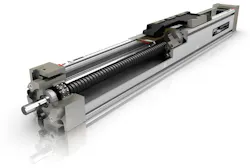
The early case for replacing pneumatics with electric actuation was energy savings. That argument never really materialized. What drove the shift was repeatability, accuracy, consistency, serviceability and, increasingly, flexibility.
That last one is underrated. Changeover on a pneumatic axis, for example, meant swapping mechanical stop blocks. An electric axis can start and stop anywhere in its stroke, so a line can run 10 of one part and then 10 of another instead of committing to a run of 10,000.
READ MORE: Do More in Less Space: Ball Splines for Medical Devices
Designers want the data for the same reason. They no longer accept that the absence of an alarm means everything worked. Did the stroke finish, or stop a 10th short? Did it reach commanded force or find nothing?
Cost, however, is the counterweight. Proposals that convert every axis to electric can push a machine’s price past what its market will pay. Fluid power remains the right answer in plenty of applications and ignoring that produces a machine that works beautifully and doesn’t sell.
Smart Has a Price, and it isn’t Always Worth Paying
Consider a resistance spot welding actuator riding a robot’s seventh axis. Any plant manager would want to know when it is likely to fail so it can be swapped before the line goes down. Adding condition monitoring to a $2,500 actuator might cost a few hundred dollars—an obvious value, until it is multiplied by the 300 actuators on that line. Most plants would rather keep spares on the shelf.
The sensing is harder than it sounds, too. Wear could show up as screw wobble, slop in the nut, heat or vibration, and separating those signals reliably is not trivial.
The more productive path is extracting more from the hardware already there. A motor and drive know revolutions, direction, torque and current draw. Combine revolutions with screw pitch and you have position and velocity without adding a sensor. Motor thermal protection is usually a switch that trips at a limit; a sensor reporting the trend toward it costs little more and tells you something.
Cleanroom and Medical: No Technology Gets a Free Pass
It is tempting to sort motion technologies into clean and unclean and specify from there. But contrary to popular belief, fluid power is no less forgiving in a cleanroom environment than electromechanical motion, which has its own potential sources of contamination, including elastomers, potential leaks, materials of construction and lubrication needs.
But fluid power at least lets the power source leave the room. A compressor can sit 100 yards away and drive 100 actuators through tubing. Electric actuation cannot. The motor has to be at the point of motion, one per axis, so every electric axis puts a potential contamination source inside the clean space.
That is not disqualifying, and it isn’t an argument against electromechanical motion in cleanrooms; the repeatability case usually still wins. But it belongs in the architecture conversation, not the component conversation. The mitigations are real—low-outgassing materials, bearing choices that keep lubricant out of the room and designs that contain whatever particulate does get generated.
READ MORE: Why Ball Splines Matter: The Motion Control Technology Behind Precision Machines
Washdown sets a related trap, since designing to hygienic standards is often not compatible with motion. The tighter the seal keeping cleaning fluid out of the actuator body, the more it constrains movement. More friction means more heat, heat swells the seal and the swollen seal clamps down harder. The problem compounds. Which is why open architecture sometimes wins: two pulleys and an exposed belt, sprayed down and replaced on a schedule.
The same logic applies at the bearing itself. A solid polymer bearing gliding directly on a stainless-steel shaft—an FDA-compliant liner doing the work grease would otherwise do—can be cleaner and easier to wash down than a ball bushing on that same shaft carrying the lubrication it requires.
Where medical applications genuinely push motion is precision and settling. Well plate density keeps climbing and on-center spacing shrinking, pushing acceptable error toward single-digit microns. Much of lab automation ends in optics, so the axis has to stop, settle and hold still. Stiffness and vibration matter as much as positioning accuracy.
Where Specification Can Go Wrong
Through all the change that linear motion faces, it becomes increasingly important for machine designers to bring motion suppliers in earlier for design discussions.
A common mistake is the motion profile, where static load gets specified but dynamic load does not. A customer might not have a thorough understanding of the parameters needed to get the job done—specifying a 10-sec. timing, for example, then realizing that the action really needs to happen in 1 sec. That sort of discrepancy can fundamentally change the motion requirements.
Getting motion components delivered in a more integrated package from a single source can also help to overcome a tendency toward stacked conservatism. A 100 lbf need might arrive specified at twice that because every handoff added its own safety factor—the component supplier hedges because it doesn’t know how the part will be used, the integrator hedges again, the builder once more. The result works, but it is oversized, costlier and less elegant than it needed to be.
Both issues trace to the same root: Engineers specify a product instead of describing the motion that they need. They pick a motion component, anchor on it and the conversation becomes about that part rather than the job. The better opening is functional: Describe the point of interest in three-dimensional space, including brackets and tooling, say what has to happen there and how fast, and let the axes fall out of that.
None of these pressures are reversing. Design teams will keep getting leaner and they will keep asking for motion that arrives more complete. Machines will keep getting denser, more distributed and more instrumented. Rails, bearings and screws are mature enough to meet all of that. What decides whether a given machine gets there is how early the motion conversation starts—and whether it starts with the job or with the part.
About the Author
Tom Ouellette
Vice President of Sales, PBC Linear
Andy Zaske
Vice President of Sales and Marketing, PBC Linear
Voice Your Opinion!
To join the conversation, and become an exclusive member of Machine Design, create an account today!
 Leaders Logo
Leaders relevant to this article: