Taking Large-Format Additive Manufacturing from Development to Production
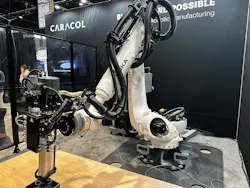
Robotic systems, hybrid manufacturing and distributed production are expanding the use of large-format additive manufacturing (LFAM). Manufacturers are using the technology to produce tooling, molds, jigs, structural components and finished parts that would be difficult, costly or time-consuming to make using conventional methods.
LFAM also extends additive manufacturing to sizes that exceed the limits of traditional 3D printing systems, making it relevant to sectors such as aerospace, marine, automotive, energy, construction and transportation. In addition to size, material costs, production volumes, part complexity and post-processing requirements all influence whether a printed part can compete with established manufacturing processes.
So, where, and under what manufacturing conditions, can LFAM deliver a measurable economic or production advantage over conventional methods?
Case histories among manufacturers testing the technology are on the rise, particularly where large-scale tooling, low-volume production runs, complex geometries or long lead times make traditional approaches less attractive. That growing interest is also evident in the expansion of companies such as Caracol, an Italian manufacturing technology firm specializing in robotic additive manufacturing.
In October 2025, the company announced a $40 million Series B financing round to support international expansion and further development of its robotic manufacturing platforms for polymers, composites and metals. Its approach to large-format additive manufacturing combines robotic motion, thermoplastic extrusion and proprietary software to produce large, complex components.
Caracol reported more than 100 robotic systems installed worldwide, hundreds of completed projects and annual revenue growth exceeding 100% for five consecutive years. While those figures are company-reported, they highlight a growing investment in LFAM as manufacturers assess where the technology can deliver production and economic benefits.
From Oversized Printing to Industrial Manufacturing
LFAM generally refers to additive technologies capable of producing parts measuring more than one meter, although there is no single universal size threshold defining the category. Unlike conventional enclosed 3D printers, large-format systems can use industrial robots or large gantry structures to deposit material over substantially larger work envelopes. Depending on the platform, they can process polymers, fiber-reinforced composites and metals.
Robotic systems allow material to be deposited along more complex paths and orientations than conventional additive systems. A six-axis robot, for instance, can adjust its position and deposition angle to accommodate geometries that would be difficult to produce using conventional fixed-axis, layer-by-layer printing.
READ MORE: How AI, Automation and Design Could Expand Additive Manufacturing
Violetta Nespolo, Chief Marketing and Strategy Officer, Caracol, said the additional degrees of freedom can also change how engineers approach part design. “Instead of using supports as much as you would in a traditional additive,” she explained, engineers can use the robot’s sixth axis, different slicing strategies and alternative build orientations.
For example, a 45-deg. slicing strategy can change the way material is deposited and potentially improve the strength of a component. The approach requires engineers to account for the capabilities and constraints of the robotic process rather than simply scaling up a conventional 3D printing design.
While the printing process is a critical step in the workflow, it represents only one stage of the production process. Caracol’s approach is centered around its Heron AM platform, which places printing, machining and post-processing within the same manufacturing cell rather than treating them as separate operations. According to Nespolo, combining those functions in a single setup can simplify production workflows and support higher-volume manufacturing. “You can have one machine that prints, machines, post-processes all together," she said. "And this allows you to scale your production effectively.”
Where the Economics Begin to Work
One of the more established applications for large-format polymer and composite printing is tooling. In aerospace, for example, manufacturers are using the technology for molds, mating tools and jigs. These applications can benefit from shorter lead times and lower tooling costs than some conventional manufacturing methods.
Caracol’s press release also cites an automotive and motorsports application with French composites specialist Duqueine, where the company reported a 50% reduction in production lead times for carbon-fiber tooling. Caracol also cites a marine manufacturing project with Ferretti Group in Italy in which some finished parts were produced at up to 70% lower cost. However, the reported savings were specific to that application and are not necessarily indicative of LFAM performance in general.
READ MORE: Five Design Tradeoffs When Using Additive Manufacturing for Production
The economics change considerably when moving from tooling into finished structural components. Nespolo identified metal applications such as structural parts, tanks and pressure vessels as opportunities for producing lightweight components and achieving cost savings. These applications also introduce different material and process requirements.
Caracol's move into metal additive manufacturing illustrates the distinction between producing tooling and manufacturing end-use parts. While the company was able to apply its experience in robotics and system integration from its polymer-based additive business, metal production introduced a different set of technical and operational requirements. Developing capabilities in metal additive manufacturing required expertise in process development, applications engineering and technical support tailored to metal production environments.
For manufacturers evaluating LFAM, the transition from polymer to metal extrusion involves more than a change in material. Experience with robotic polymer systems does not automatically translate to producing qualified metal parts, which require different process controls, material handling practices and quality-assurance procedures. Those requirements become more stringent in regulated industries, where component performance, traceability and certification are often subject to industry-specific standards.
A Six-Meter Catamaran Illustrates the Scale
One of Caracol’s largest projects involved producing an electric catamaran with a Spanish company. The vessel, about six meters long, said Nespolo, was printed as a single part using recycled polypropylene. Printing took more than six days, after which the customer painted the vessel to achieve the desired appearance.
The project demonstrates both the scale possible with robotic extrusion and the economic questions that accompany large format production, including material performance, build time, finishing requirements and repeatability.
For marine manufacturers, reducing tooling requirements, consolidating components and using alternative materials can offer production advantages. Whether those advantages translate into lower costs depends on factors such as build time, material consumption, post-processing requirements and production volume.
The economics differ from those of conventional high-volume manufacturing. Injection molding, for example, becomes cost-effective as tooling investments are spread across large production runs. LFAM may offer an advantage where production volumes are relatively low, tooling costs are high, or part size and geometry make conventional manufacturing less practical. Its value ultimately depends on whether it can simplify production enough to offset material and processing costs.
Hybrid Manufacturing Moves Large-Format Additive Closer to Production
A significant development in LFAM is the integration of additive manufacturing with other manufacturing operations. Rather than treating printing as a standalone process, manufacturers can combine robotic deposition with machining and post-processing in a single production cell. This allows material to be deposited close to the required geometry, with machining used to achieve final dimensions and surface characteristics.
Caracol's approach is to integrate the hardware, software and automation required to manage these operations. According to Nespolo, the objective is to integrate printing, machining and process control into a production system rather than supply a standalone large-format printer. Developing the company’s metal additive manufacturing technology, however, required a separate investment in engineering and development. “But it still took three years of development before we went to market with a new technology on the metal side,” Nespolo said.
READ MORE: How Hybrid Manufacturing Combines CNC and 3D Printing for Accelerated Product Development
Consistency in material deposition, build orientation and processing conditions is essential when producing components that must meet defined engineering specifications. For applications in aerospace, energy and other regulated industries, manufacturers must also demonstrate that those processes can be controlled, validated and repeated reliably.
Nespolo said Caracol's facilities operate under AS 9100 certification, supporting its work in sectors with demanding quality requirements such as aerospace and defense. The company is also extending its metal additive manufacturing capabilities into applications such as nuclear energy, where the quality expectations and process knowledge developed in aerospace can have relevance.
Distributed Manufacturing and the Microfactory Model
Another potential advantage of LFAM is the ability to locate production closer to where parts are needed. Large components can be expensive and difficult to transport, particularly when they are oversized or require specialized handling.
Nespolo said Caracol designed its robotic platforms to be deployed in modular cells that can be containerized and moved closer to manufacturing sites or customers. ‘You can put it into a container and modularize it and bring it around and be close to where you want the parts to be built,” she said. That approach supports Caracol’s distributed manufacturing model, which relies on regional production facilities and manufacturing partners to serve local demand.
Locating production closer to the point of use could reduce shipping costs and lead times, particularly for large components. Modular cells also allow manufacturers to reconfigure production for different parts and applications without dedicated production lines. However, distributed production still requires expertise in material processing, programming, quality control and finishing. Its economics depend on machine utilization, qualified personnel and a sufficient pipeline of work to justify the investment.
Caracol’s origins as a manufacturing service bureau have shaped how the company supports customers adopting this model. Nespolo said the company initially developed its own hardware, software and automation to produce parts that existing technologies could not accommodate. As customers began installing the systems in-house, demand grew for training, process development, application expertise, and software and hardware support.
Where LFAM Goes Next
Caracol’s $40 million financing round reflects investor confidence in the potential for robotic manufacturing to expand into additional industrial applications. The company reported plans to use the funding to expand internationally, develop its multi-material and multi-process platforms, advance software and automation capabilities and accelerate its metal additive manufacturing business.
Expansion into metal additive manufacturing also points to growing interest in applications outside the technology’s traditional focus on tooling, molds and large composite structures. Aerospace, defense, energy and maritime companies are among those evaluating additive processes for structural and performance-critical components.
As the technology matures, attention is turning to questions of production consistency, process qualification and cost. While tooling and large-format custom parts remain the most established LFAM applications, metal additive manufacturing is widening the range of parts under consideration for additive production. Still, whether those applications gain wider traction will be determined on the factory floor, where quality requirements, certification standards and economics ultimately shape manufacturing decisions.
More content from IMTS 2026.
Have a question, comment or idea? Get in touch with the Machine Design editors at [email protected].
About the Author
 Rehana Begg
Editor-in-Chief, Machine Design
As Machine Design’s content lead, Rehana Begg is tasked with elevating the voice of the design and multi-disciplinary engineer in the face of digital transformation and engineering innovation. Begg has more than 24 years of editorial experience and has spent the past decade in the trenches of industrial manufacturing, focusing on new technologies, manufacturing innovation and business. Her B2B career has taken her from corporate boardrooms to plant floors and underground mining stopes, covering everything from automation & IIoT, robotics, mechanical design and additive manufacturing to plant operations, maintenance, reliability and continuous improvement. Begg holds an MBA, a Master of Journalism degree, and a BA (Hons.) in Political Science. She is committed to lifelong learning and feeds her passion for innovation in publishing, transparent science and clear communication by attending relevant conferences and seminars/workshops.
Follow Rehana Begg via the following social media handles:
LinkedIn: @rehanabegg and @MachineDesign
YouTube: @MachineDesign-EBM
Related
 3D-printed jet engine model

Voice Your Opinion!
To join the conversation, and become an exclusive member of Machine Design, create an account today!
 Leaders Logo
Leaders relevant to this article: