Building the Business Case for Robotic Machine Tending
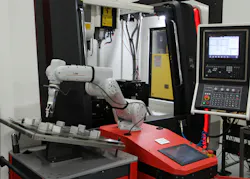
Whether a machine shop needs to overcome labor-related challenges or simply needs to increase production output, robotic machine tending is often one of the best ways to achieve those goals.
For companies that are new to robotic machine tending, knowing how to get started can be intimidating, but it doesn’t have to be. The first step is to clearly define the problem and quantify the gains that a solution will achieve. In other words, what is the most pressing need?
Is there a high-volume part, or family of parts, that the robot can load and unload to free up a machine operator to address a higher-value task? Will increasing the number of hours a particular CNC runs per day enable additional orders to be filled? The most important pain point will lead to the next step: quantifying the benefits of automation.
A return-on-investment calculation will eventually be necessary, but an accurate figure cannot be developed until the rough cost of the system is known. At this stage, however, OEMs and system integrators can help machine shop customers begin estimating the potential benefit.
READ MORE: Q&A: RaaS—The Subscription Model That’s Steadily Rewiring Robotics
The ability to produce a part around the clock does not create value if the shop does not have enough demand for that part, or if the added capacity cannot be redirected to other work. Factoring in “found” production time can positively influence the ROI period and help customers better understand the business case for automation.
For example, a robotic machine tending system with one hour of storage for new and processed parts may provide 10 hours of incremental production per week. Most facilities have a pair of 15-min. breaks and a 30-min. lunch break per day. Making sure that the storage system is loaded prior to these breaks and then again at quitting time would net two hours of production per day. Over a five-day workweek, this is 10 hours of production and an entire 40-hour week per month.
Of course, not all automation projects will see this amount of increased production, but many will. If a machine shop has never considered using robots to bolster workforce or production, it may be falling behind competitors and not even know it.
Intel Robot’s 2026 readiness report states that leaders, on average, believe that “deploying a robot will be more cost-effective than hiring a human in their sector within three years.” They add as a disclaimer, “It’s not about replacing people, but creating new forms of human-machine collaboration, with robots working alongside employees as productive teammates.”
Weighing the Trade-Offs Between Machine-Tending Options
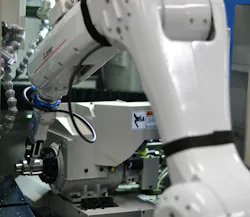
Once the benefits of a robotic machine tending system and a candidate application are established, what type of robotic system is best? There are three typical options: robot only, pre-engineered system and fully integrated solution. All have their strengths and weaknesses and the best solution may change over time.
Robot only. This gives the most flexibility but requires the largest internal time commitment. This option may be appropriate when the customer has someone on staff with relevant robotic programming experience and familiarity with the full scope of a robotic system, including safety, HMI development and communication with the CNC.
OEMs and system integrators should also help customers evaluate whether that internal resource has enough available time to design, build, install, test, document and support the system, as well as train operators. One potential risk is long-term supportability. If the customer’s internal automation resource leaves the company, keeping the system running or reprogramming it for new parts may become a challenge.
From a cost perspective, the initial cash outlay is typically the lowest with this route, but the customer’s internal engineering time should be included in any calculation of total system cost.
Pre-engineered solution. This system reduces much of the design burden of the robotic system. A typical pre-engineered solution consists of a robot, base, safety and often a PLC that acts as a cell controller. The user has to add programming, a gripper (or fingers, if a gripper comes with the system), a parts storage system, a user interface and communication to the CNC.
There will need to be an ample amount of time available to “finish,” test and document it, but a pre-engineered solution eliminates a lot of the design and fabrication work. The experience gained while turning this into a working solution can be used when it is time to modify the system or add new parts. As expected, this system will have a higher external cost than a robot-only solution, but the cost and burden on engineering staff will be less.
Full turn-key solution. This system is exactly as it sounds: a system designed by an experienced third-party integrator based on the customer’s needs. While the integrator does most of the work, the end user will still need to have a project lead participate in several decisions in order to ensure that the final product meets the end-user’s goals.
In a typical turn-key project, the integrator manages the system design, build, programming, testing, documentation and training. There is often a runoff at the integrator’s facility before shipment, followed by a second runoff on the customer’s floor once the system is installed and communicating with the CNC. This route generally carries the lowest implementation risk, but it also has the highest external cost.
The demand on the customer’s engineering resources is much lower than with the other approaches, although design reviews, runoffs and internal coordination still require time and attention. Future hardware or software modifications may also be more costly, especially if the customer has limited in-house automation expertise.
Evaluating Cost, Flexibility and Long-Term Value
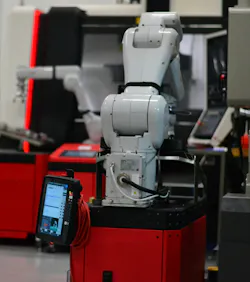
Regardless of the option chosen, communication with the end-user’s CNC is a key part of any system. Work with the CNC provider ahead of time to determine if there needs to be any modifications to the CNC’s ladder logic or controls to add this functionality.
Adding an automatic door opener to the CNC will be more consistent and faster than programming the robot to do it. Features such as a part/chuck blow off, part rotation when a re-grip of the part is needed and a two-headed gripper to facilitate faster part exchange need to be considered as well.
Once the production benefits and the total anticipated system cost are verified, a more accurate ROI calculation can be done. The key to this calculation is to have realistic estimates of both production improvements and the total system cost.
READ MORE: Q&A: Robco on Robotics-as-a-Service and the Move Toward Physical AI
What else can be done to improve the likelihood of a successful machine tending robot system? Here are a few suggestions:
- Work with suppliers who have the right experience—ideally, someone who has both CNC and robotic automation experience. Even with a robot only route, there are many benefits in working with a partner that has experience in gripper design, CNC modification and communication and safety.
- Pick the right machine to automate. The cost-justification is based on improving the efficiency of production. Adding a robot to an older CNC is fine; in fact, we just had an integrator add a robot to a 20-year-old lathe. But whether old or new, the CNC selected must be one that has a proven record of trouble-free operation.
- Consider the most profitable way to pay for robotic machine tending systems. Beyond a capital purchase, there are leasing options and innovative solutions such as Robots as a Service (RaaS) programs, where end-users pay by the month with nothing due up front. Some of these RaaS-based offerings include performance guarantees, equipment upgrades, maintenance and reprogramming in the monthly fee.
According to Allan Gibson, Head of Product Innovation at Formic—a company that offers RaaS-based solutions for a variety of industries, including machine tending—a RaaS program could substantially reduce risk for all machine shops, particularly if they are exploring robot automation for the first time. “Robots-as-a-Service moved automation from a capital decision to an operating expense, but in most programs, the manufacturer is still the one carrying the integration risk,” Gibson said.
“Full-Service Automation takes it a step further,” he continued. “The provider scopes, engineers, installs and supports the cell—including new parts added later—under one flat monthly rate, and the customer doesn’t pay a dollar until the system is running on the floor and performing as intended."
At Mitsubishi Electric, we are seeing a clear uptick in machine shops that are considering robotic automation for the first time. They run the gamut between small shops with five or fewer employees to larger outfits with 25+ CNCs in operation. Interestingly, we are also seeing some of the larger companies that have previously automated a few processes coming back to investigate a more comprehensive automation strategy.
Many have found that while the automation that they have on their floor has helped their bottom line, scaling up requires a more deliberate, planned approach. In addition, robots are being used to supplement existing staff, allowing operators to move to more interesting and higher-value tasks.
On the other hand, one trap that we often see first-time users falling into is inactivity. If the justification and need are there, we want to help shops realize the benefits as soon as possible, rather than finding themselves halfway through 2027 thinking that they should have automated machine tending back in 2026.
Labor cost, skill and availability issues aren’t going away any time soon. Even if end-users can identify available workers, they are less likely to have the skills needed to contribute from Day 1. Deloitte and The Manufacturing Institute’s Manufacturing Skills report from 2025 states that nearly 50% of open roles remain vacant due to a lack of skilled candidates, and 80% of manufacturers report that the labor shortage is disrupting their production.
The math behind getting the most out of a CNC investment will not be changing, either. The manufacturers that survive and thrive in 2026 and beyond will be the ones that address these conditions most efficiently and effectively. Adding robotic machine tending to a shop floor is a low-risk, proven way to address many of the challenges that today’s manufacturers are facing.
More content from Takeover Week: Automation & Robotics.
About the Author
Patrick Varley
Industry Marketing Manager (Robotics), Mitsubishi Electric US - Industrial Automation Division.
Patrick Varley is the Industry Marketing Manager (Robotics) at Mitsubishi Electric US - Industrial Automation Division. He has more than 30 years of experience in Robotics, Machine Vision and Industrial Automation, and is responsible for helping machine shops of all sizes address labor and productivity challenges while reducing risk and increasing production.
Voice Your Opinion!
To join the conversation, and become an exclusive member of Machine Design, create an account today!
 Leaders Logo
Leaders relevant to this article: