NB Corp. Demonstrates Integrated Linear Motion for Precision Automation at IMTS 2026
NB Corporation of America had precision linear motion technologies on display at IMTS 2026 in Chicago, with live demonstrations focused on machine design, automation, robotics, semiconductor processing and high-accuracy inspection.
With more than 80 years in linear motion, the company highlighted two core technologies in the Automation section: Slide Ways, based on cross-roller technology, and BG Actuators, which integrate a linear guide and ball screw in a single unit.
Two technologies anchored NB’s IMTS exhibit—and its long history in linear motion: Slide Ways, built around cross-roller technology, and BG Actuators, which combine a linear guide and ball screw in a single unit. “Our core is our Slide Ways, which is our cross-roller technology, and our BG Actuators,” said Brian Pinkham, Director of Sales for the Americas at NB Corporation of America.
Where Are NB Slide Ways Used?
The Slide Way demonstrations showed how precision linear motion supports applications requiring smooth, repeatable movement. NB’s cross-roller Slide Ways use precision, non-recirculating rollers, while its anti-cage creep technology is designed to prevent retainer migration during repetitive motion.
“Due to the extremely high accuracy over its stroke, Slide Ways are very popular in the semiconductor industry,” said David Cowan, application engineer, NB Corporation of America. He pointed to applications including material transport and etching, where motion must remain smooth and flat, as well as inspection and optical equipment.
READ MORE: Siemens Targets Faster CNC Ramp-Up with “Meet at the Machine” Initiative
Cowan also cited applications outside semiconductor manufacturing. “We’ve even seen, for example, Gonio Ways with the rotary element used in an X-ray backscatter machine, where they use this in order to target where the backscatter is aimed so they can make certain it goes into their sensors,” he said. Other high-accuracy applications include medical equipment and microscopes.
NB’s precision alignment demonstration brings the Slide Way and Gonio Way technologies together in a six-axis system. Three axes of linear motion are combined with three axes of rotary motion to align a pin with a matching hole. The Gonio Way adds angular positioning to the high-accuracy linear movement of the Slide Way, allowing the system to maintain precise alignment as the position changes.
The six-axis demonstration also shows that precision depends on how the motion components work together. Even highly accurate guides and bearings need to be properly aligned and coordinated to achieve the required positioning accuracy.
How do BG Actuators Simplify Linear Motion Design?
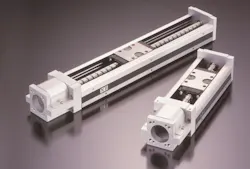
That issue was captured in a BG Actuator demonstration. The actuator combined a linear guide with a ball screw, eliminating the need to separately align those components when building a linear stage. “When you're dealing with a linear stage, one of the challenges that you face is that you need to make sure that all the elements of it are properly aligned with sufficient accuracy,” Cowan said. “Our BG actuators are a combined guide with ball screw down the middle. It's going to save you a lot of time and effort in designing and assembling your machine.”
The integrated design combines a rigid profile with the precision of a ball screw drive, Cowan said, allowing the actuator to be mounted directly to a machine or configured as a cantilevered axis. “You can put it on simple brackets to get a full three-axis configuration,” he said.
READ MORE: Universal Robots Launches Gen 7 Platform for AI-Ready Industrial Automation
That configuration was used in a pick-and-place system to move items between positions. The exhibit illustrated the potential design advantage of using a pre-integrated motion axis rather than assembling and aligning the guide and drive separately.
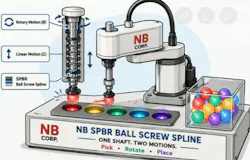
A separate SCARA-style pick-and-place demonstration used NB’s Ball Screw Spline to combine independent rotary and linear motion in a single shaft. The system’s capabilities included picking up, rotating and placing illuminated balls, demonstrating a configuration that can reduce component count, space requirements and system complexity.
Rounding out the exhibit, a Rotary Ball Spline demonstration featured an illuminated pipette mechanism that simultaneously elevates and rotates, showing how linear and rotary motion can be coordinated within a compact mechanism.
More content from IMTS 2026.
Have a question, comment or idea? Get in touch with the Machine Design editors at [email protected].
About the Author
 Rehana Begg
Rehana Begg
Editor-in-Chief, Machine Design
As Machine Design’s content lead, Rehana Begg is tasked with elevating the voice of the design and multi-disciplinary engineer in the face of digital transformation and engineering innovation. Begg has more than 24 years of editorial experience and has spent the past decade in the trenches of industrial manufacturing, focusing on new technologies, manufacturing innovation and business. Her B2B career has taken her from corporate boardrooms to plant floors and underground mining stopes, covering everything from automation & IIoT, robotics, mechanical design and additive manufacturing to plant operations, maintenance, reliability and continuous improvement. Begg holds an MBA, a Master of Journalism degree, and a BA (Hons.) in Political Science. She is committed to lifelong learning and feeds her passion for innovation in publishing, transparent science and clear communication by attending relevant conferences and seminars/workshops.
Follow Rehana Begg via the following social media handles:
LinkedIn: @rehanabegg and @MachineDesign
YouTube: @MachineDesign-EBM